Untold Process

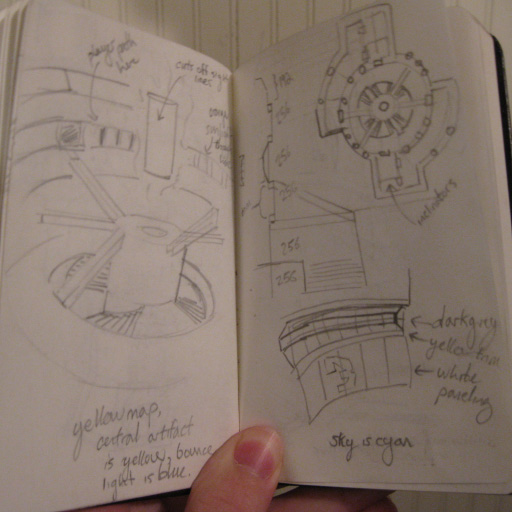
Between classes I’m a writing tutor. Sometimes my students don’t show up. When this happens, I pull out my sketch book. That’s how the design for my latest level came to me.

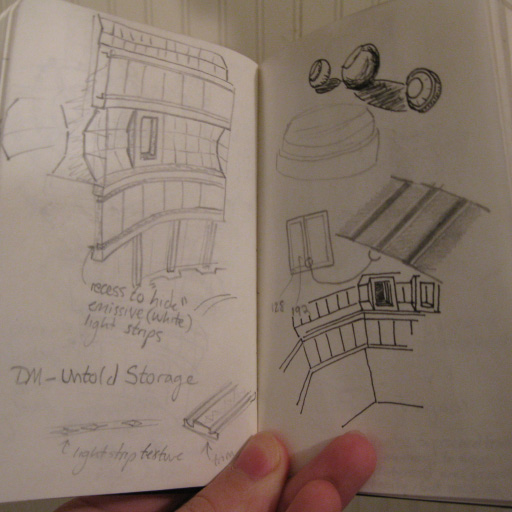
Sketch_1

I started by drawing several pillar figures (visible on the right page of the image above). I was thinking about the geometry style in Halo’s multiplayer levels. I started sketching ideas around it, and then hastily drew the general layout at the bottom of the page before I lost the thought. (The left page was from another day when another student forgot to show.)

Sketch_2

The second page reiterated the idea with some variation. Rather than having all of the beams lead to the center, like the ramps in the Halo’s Wizard, some rose and others fell (more like the ramps in DM-Deck). The third page added complexity to the layout. There’s very little difference between this and the final level. Even the funiculars (written as inclinators) are noted. Next to this layout is a height analysis. I also started guessing color tones and texture styles that might work.

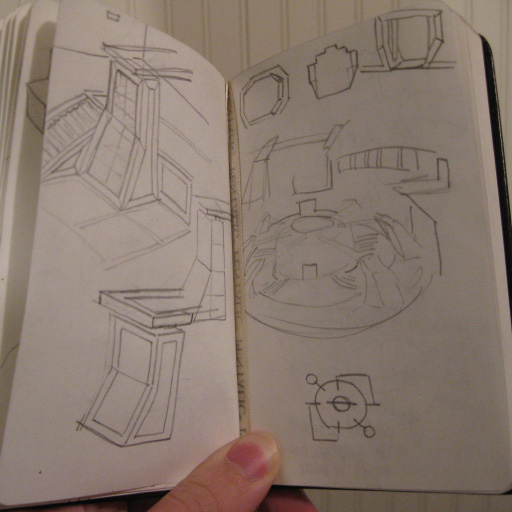
Sketch_3

The fourth page cuts away from the wall to expose its depth, but there’s little here I hadn’t drawn before. I drew the fifth page later, once I had toyed with the brushes in the editor and remembered how bad Unreal’s curve collision is, so I redesigned the level as an octagon instead of a circle. The rest of the final page is nonsense doodling.

I’m frankly surprised at how well the level came together. Usually my levels see several iterations, and the transition from a 2D idea to a 3D space seldom goes so well.

A Theory of Cooperative Competition

In cooperative games, players act against a common opposition, while in competitive games players oppose one another. I want to approach these terms—competitive and cooperative—in a different way. Instead of a struggle for shared success, it is useful to define cooperation as a struggle for shared enjoyment.

This definition decouples success from enjoyment, because there can be enjoyment in defeat. When I die in a game to protect my friends regardless of their success without me, when a friend suddenly falls and our virtual mortality is made tangible, or when we resist defeat in a glorious last stand, we have found an enjoyment distinct from success. These examples are a narrow sampling of cooperative gameplay. Cooperative enjoyment can also be part of competitive games. Consider the following examples:

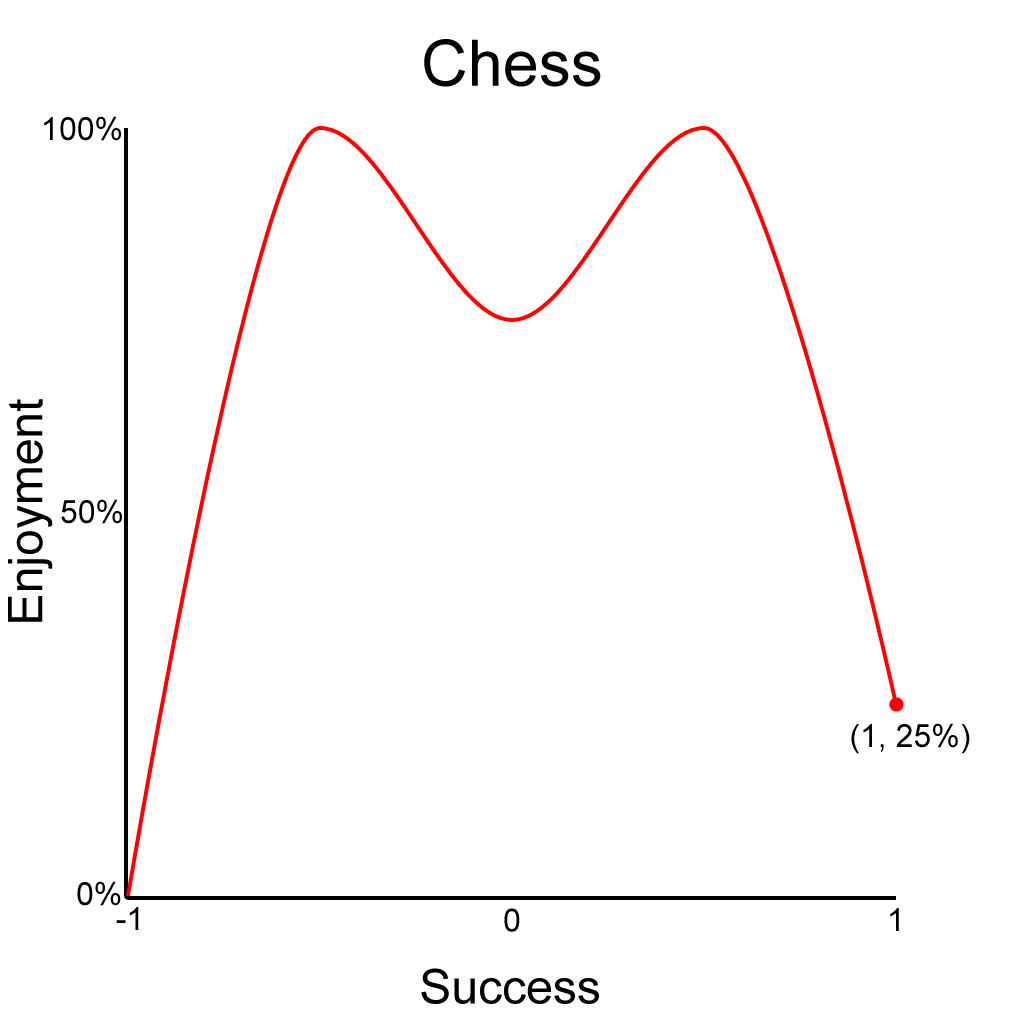
Chess has four general outcomes. 1) Player A wins by a significant amount, and Player B loses. 2) Player A loses by a significant amount, and Player B wins. 3) Player A and Player B tie. 4) Player A wins or loses in a close game.

Because Chess is competitive, success would only be upon victory. This means that outcome 1 is the goal, followed in order of desirability by outcomes 4, 3, and 2. However, anyone who has played Chess knows that outcomes 1 and 2 are the least interesting; a four-move checkmate is only amusing the first time.

The ideal chess game is outcome 4, a series of cunning traps that are detected and circumvented until one succeeds, regardless of victory or defeat. This reality makes more sense from the perspective of cooperative enjoyment than from the traditional notion of competition. Both players are cooperating for the shared enjoyment of outcome 4.

There is also an unusual amount of trust involved. Stronger players might remove pieces, modify rules, or secretly weaken their strategies as handicaps to increase the likelihood of outcomes 4 and decrease the likelihood of outcomes 1 or 2. Either player could also intentionally lose, forcing outcomes 1 or 2, and eliminating all enjoyment. There is a mutually expected sportsmanship.

Chart_Chess

A visual summary of Chess

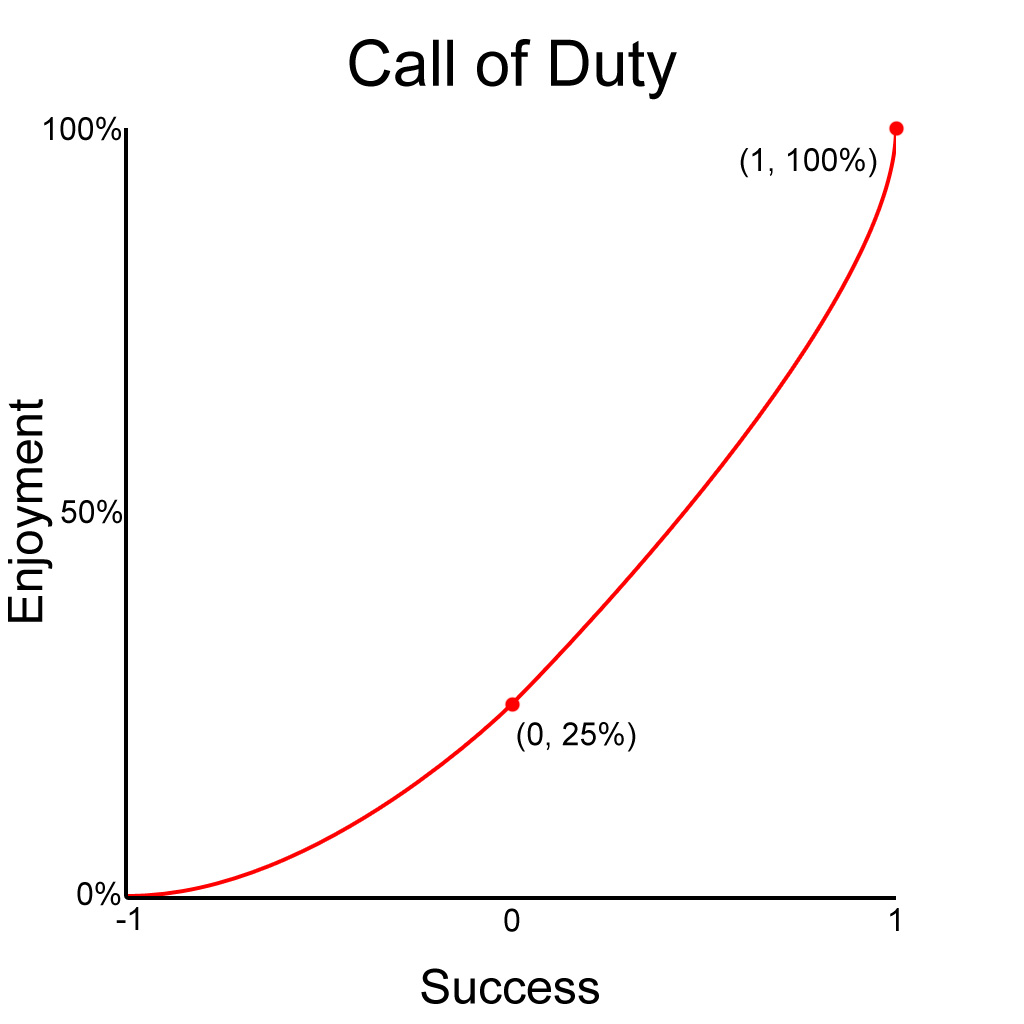
The second example is Call of Duty (any of the games since 2007’s Modern Warfare will do). There are three general outcomes in a multiplayer match of CoD. 1) Player A’s kill-death ratio is negative. 2) Player A’s kill-death ratio is positive. 3) Player A’s kill-death ratio is neutral, give or take. This is a specific way of playing CoD; most players ignore deaths and focus instead on whether they were on the winning team or not. However, kill-death ratio is the only way a player can influence my team’s success or failure, so that is the metric I chose. (If recent CoD games offered support interaction, like the medics of CoD3, this would not be the case.) Even so, these categories are scalable down to each engagement in a match, and up to a session of matches without changing my findings.

The only enjoyable outcome is 2. Like any effective random reward schedule, outcome 2 happens just often enough for players to continue playing. Outcome 1 leaves players frustrated, but there is a need to redeem oneself and play “one more match.” Outcome 3 is almost as bad, because players know they are capable of outcome 2. And so they play again.

Most modern competitive shooters amplify these problems. They are designed for competition (and victory), rather than cooperative enjoyment. CoD’s “score streaks” unlock bonuses (e.g. airstrikes, helicopters, dogs) that behave as positive feedback loops. These bonuses cause arbitrary death, which causes the positive feedback loop of frustration. Unreal Tournament 2004’s “adrenaline” also unlocked bonuses (e.g. invisibility, health regeneration, speed boost), but these were not arbitrary.

Unlike Chess, there is no way to examine CoD for cooperative enjoyment. Even if players have friends on their team, the only cooperative interaction is by sharing tactical knowledge, and the benefits of this in CoD are limited. In short, CoD’s multiplayer is severely asocial.

Chart_CoD

A visual summary of CoD

TLDR; A multiplayer game’s encounter/match/session needs to be intrinsically satisfying, or else only victory will be. Thinking of competition through the perspective of cooperative enjoyment may help in achieving this.

Note: the graphs are visual representations of my quantified subjective experiences. They are not based upon data I have collected. I could have made the curve steeper for Call of Duty, or scored a tie in Chess less enjoyably, so read them cautiously.

On Multiplayer Level Design: Basics

I’ve designed amateur levels for a while now.¹ For each level, I’ve attempted to explain the rationale behind my specific layout or weapon choices, yet I’ve never written about a general theory of multiplayer level design. That is the point of this post.

Below are several abstracted principles, and though I’ve written them as absolutes for clarity’s sake, they are my subjective observations. The first three principles should be apparent; these are my advice for new level designers. The last three are debatable, so I have attempted to defend them in the text below.

1. A successful design follows from familiarity with the game. Play until you understand.

2. Playing games is necessary, but not sufficient, to understand them.

3. Understanding differs from skill. Inept players can be capable designers.

4. Levels do not exist in isolation.

5. Mechanics inform, but do not determine, level design.

6. Levels are the medium through which players encounter a game’s systems.²

In early 2008 I purchased Unreal Tournament 3 because it had a level editor, not because I loved Unreal. My early levels were flawed by this; they played like Call of Duty, Halo, or whatever I was playing at the time. This isn’t a problem that goes away either. My latest designs are visibly influenced by Quake III. The solution is to be aware of these influences when designing.

In the early Unreal games, there was no codified style. Unreal suffered from imbalanced and redundant weaponry. Although UT99 reduced these problems, the level style was inconsistent. Compare Inoxx’s SpaceNoxx or Pyramid to Akuma’s Viridian or Malevolence. The divergence of styles made UT99 many games in one.

UT2k4 and UT3 were more consistent. Separate styles bound the levels to their respective games. Checker’s Ironic belongs to UT2k4, not UT99 or UT3.³ This same stylistic consistency is true of Quake III, Team Fortress 2, and Counter Strike. I could build Dust in Unreal, but I would be ignoring both mechanical and stylistic differences between the two games. Dust would not be an ideal expression of “Unreal-ness.”

Yet, when modding for UT3 was at its peak, ports of Quake III levels were common. From a mechanical view, these two games are almost identical. The movement, the weapons, and the power-ups are similar. They could be the same game. The style of their levels is incompatible, though, and it’s at this point that most ported levels failed.

One-way paths, dead-ends, and narrow corridors are typical of Quake levels. These elements reinforce strategies built around timing pickups. Many paths are pointlessly dangerous without timing items correctly. UT2k4 and UT3 levels avoid this style of design. Although timing is a part of strategic play, predicting the enemy’s location relative to one’s own is more important.

There are exceptions in both games, though. Quake III’s Vertical Vengeance is compatible with UT3 (Moonflyer built an excellent port), and Inoxx’s UT99 levels are arguably more compatible with Quake than with Unreal. Despite these exceptions, I think my points about the role of level design still stand.

This summer I had a brief, freelance level design gig. An independent programmer needed levels for his mechanically complete game. He requested something like Quake or Unreal, and though there were several design restrictions, he gave me enormous freedom. By designing the first multiplayer level for the game, I was central to defining the style, and—by extension—defining the game.

In designing levels, even as an amateur, be aware. No level exists in isolation, and familiarity with a game’s style and mechanics is essential when designing levels for it. Reviews seldom mention level design, and indies are quick to cut corners, but its role can’t be ignored. If nothing else, remember that to design, you have to play.

Notes:

¹ I use “amateur” in both senses of the word. I design my levels out of love for the process, but I’m also not paid for my work.

² In games like Skyrim, I consider both the main world and individual dungeons to be levels. There are also many games without levels; this principle doesn’t apply to them.

³ Checker’s Ironic was originally built for UT2k3, not UT2k4. However, the two games and their level design styles are much more similar to each other than they are to UT99 or UT3.
Favorite Games (part 2)

Previously when I explained my favorite games, I avoided spoilers. This time spoiling is unavoidable. Also last time the games were fairly old. Instead, these are recent. If you like, read this as my “favorites of 2012” list.

Proteus: I’m not a spiritual person, and I’m even less religious, but there’s something to Proteus I can’t explain. It’s a meditative experience. It’s a mirror for introspection. It’s a simple game, but I’m awed by the simplest sights: an apparition, a giant tree, statues that change the sky, and mushrooms that change the sound. With subtle musical interactivity, even common things—rain, snow, the cycle of day and night—make me grin. Proteus makes me feel like a kid jumping in puddles.

Beyond these simple moments, I think there’s a greater metaphor in the seasons of Proteus for the seasons of life. The first time I completed the game, I rushed to see all of the “content,” and then it was winter and it was too late to return. In playthroughs since then, I’ve forced myself to slow down and appreciate the many strange little things (bees!).  I can’t guarantee everyone will have the same experience with Proteus, but I know it’s made me a better person.

Thirty Flights of Loving: When I watch action movies, I want the escapism of unreality, but also something tangible. This balance is difficult, or so the average (awful) action movie would suggest. I think that’s why the heist and spy subgenres are so successful. There’s inherently more human drama than in most action movies. Thirty Flights fits in these subgenres, but it’s more successful for juxtaposing the extremes of reality and unreality through its montage of interactions. Action movies say that happiness is explosions, riches, and sex. Thirty Flights says that happiness is peeling oranges, riding motorcycles at dawn, and examining museum exhibits. It tells me, “don’t wait for big moments to be happy; little moments are beautiful too.” These simple, even mundane, human experiences are delivered so powerfully, Thirty Flights is worth your time.

Note: I know. I’m hopelessly sentimental.

Favorite Games (part 1)

A few years back during something like a job interview (sort of) I was asked about my top ten favorite games. I was unprepared, and I explained poorly. More recently I’ve wanted to write articles about my favorite games, assessing why they’re good. Yet my thoughts are still too unstructured to complete these would-be articles. As a temporary substitute, here’s an unordered list of several favorite games, and my condensed reasons why.

Banjo Kazooie: Much of my love for this game, I admit, is nostalgia. Yet when I replay it, the level design still surprises me. Levels for 3d platformers can be simple obstacle courses and still be fun for it (see Mario 64), but they can be more. Often the levels in Banjo Kazooie follow the imaginative themes of childhood adventures: a pirate island in Treasure Trove Cove, a jungle in Mumbo’s Mountain, or Egyptian ruins in Gobi’s Valley. The same adventurous themes are typical of Calvin and Hobbes comics, and my lego constructions as a kid. Other levels represent more abstract ideas. Freezeezy Peak captures winter and holiday joy, as does Mad Monster Mansion with Halloween. The best level, however, is Click Clock Woods, which embodies time through seasons, and (by extension) life. I think there is something inherent to platforming mechanics that suggests an arrow of time; collectibles can’t be undone (Mario can’t walk backwards). Before I realize it, I’ve completed the game, I’ve “grown up,” and there’s no going back.

Psychonauts: The reason for my love for Psychonauts overlaps with my reasons for Banjo Kazooie. The game is a powerful coming of age story, with glimpses of a deeper hero’s journey, and the last level is a wonderfully Freudian conflict. The gradual isolation in the hub level that sets in with nightfall is almost as effective for me as Banjo Kazooie’s Click Clock Woods. I don’t want to spoil the experience here, so let me focus on level design instead. Levels can be expressionistic creations and biased narrators, but instead our industry is obsessed with realism. Levels can be characters, and this is where Psychonauts succeeds. The Milkman Conspiracy explains a character through level design alone, and the result is more powerful and more subtle than possible through text or voiceover. This took a remarkable amount of trust. Another level, Black Velvetopia, is a self contained narrative overflowing with symbolism. Even though the design in Psychonauts is sometimes sloppy, the narrative, emotional, and stylistic power is seldom matched.

Super Mario All Stars: I specifically mean the snes version of Super Mario Bros because I can’t speak for the original. There’s not much nostalgic bias here. I first played the game when I was young, but I was never very skilled, and I don’t think I ever made it past world 4 (even with the first warp zone). This year I finally completed the game, and in the many times I’ve replayed it since, I continue to discover. At the moment—and I expect this will change—I think the best way to understand Mario is to compare it to music, especially Bach. The individual voices/mechanics are simple, but the complex interaction and variation on themes creates a powerful whole. Level 5-3, for example, is identical to 1-3, except for the addition of bullets, but the design changes completely. There are patterns to the levels in Mario, but repetition always says something new, which can’t be said of the repetitive gameplay loop in most games. To me, Mario is the exemplary of elegant game design.

I hope my thoughts encourage you to play these great games.