Fuzzy Cooperation in PvP Games

Throughout the Practice 2018 design conference there was a question of building games around cooperation and negotiation. Several talks referenced the prisoner’s dilemma and its payoff matrix as a way to describe a range of outcomes for cooperation and competition. Through conversations, this problem solidified: how do we build cooperation into traditionally competitive multiplayer games? A successful solution to this problem requires cooperation and competition to both be viable and fun strategies.  (Idling in a tied match until the server instance shuts down is neither). I also think these strategies should exist inside the game’s systems and mechanics instead of relying on the social dynamics that surround multiplayer games.

Fuzzy Cooperation in Battle Royales
To me these question are a response to the popularity of last-player-standing battle royale modes and the mainstream industry’s shift toward multiplayer. For the codified battle royale format, there is no cooperation in solo play. Even in squad variants, cooperation is limited to a tribal Us vs Them. These games lack mechanics to build and maintain social contracts, and there are few interactions that can benefit multiple teams. There is nothing to negotiate. At best, two teams may independently decide to keep their distance instead of fighting, or to pick on another team first.

For Player Unknown’s Battlegrounds, intentional team killing in squads and teaming up in solo play are against the rules of conduct and can be punished by a ban. There are some good reasons for this. If players were allowed to team up in solo mode, they would gain unfair advantage, which would undermine competitive play and hurt the game as an esport. In Fortnite’s code of conduct, players are told to “Play fairly and within the rules of the game”, and Epic has penalized players who team up in solo mode.
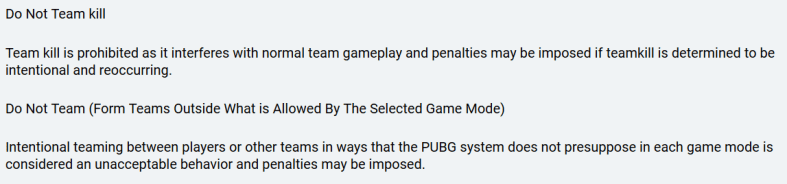
PUBG_CodeOfConduct.PNG

Screencap of PUBG’s Rules of Conduct

This is a significant divergence from the original inspirations for battle royale game modes. DayZ, a mod for Arma II, put its players and zombie AIs together in a huge map. Around its initial release, players were unfamiliar with the mechanics and were afraid of the zombies. As a result, those new players would signal willingness to cooperate so they could better survive. Over time, players learned the rules of the world and players formed groups. These gangs became bigger threats than the predictable zombies, which turned the game into a cruelly tribal PvP experience where kidnapping and enslavement became norms. DayZ succeeded as a multiplayer story generator, and it demonstrates both the positive and dangerously negative outcomes of fuzzy cooperation.


Another inspiration these game modes claim is the film Battle Royale about a class of students in Japan who are forced to fight to the death on an island with no escape. Unfortunately, the game modes only draw inspiration from the setting and its rules, not the social dynamics that emerge in the story. Only a few students in Battle Royale are eager to kill their classmates, and most of the students reject the rules and try to cooperate and escape. On top of being an exciting action film, Battle Royale is about generational conflict in Japan, where youth are expected to enter a competitive, zero-sum business world. The Hunger Games series falls into a similar category for a Western audience. In both of these works, the only ethical moves are to break the rules, and that gets messy when trying to survive against competitors who are acting within the immoral rules.

When I worked on a battle royale for a few months, I wanted the mode to return to its source material. In the early iterations, I had a few lofty goals (which we didn’t get to explore):

1) undermine competitive play in favor of generating unique stories. Surprise and uncertainty are the best tools for generating stories in multiplayer, and they comes at the cost of fair competition. This also means keeping the game accessible for new players by limiting the skill ceiling and going wide with systems instead of deep.

2) create ways for players to break the rules of the battle royale. My hope was to include some improbable system for a cooperative victory. (My example for this idea was to randomly spawn a “One Ring” that players could destroy in “Mount Doom” on the far side of the map.) This goal of breakable rules also means encouraging dynamic teams where cooperation and betrayal are both valid play.

3) keep death meaningful. A dead player shouldn’t back out to the menu and launch a new match as though they were respawning in an arena FPS. They should feel investment in the story of their teammates and the world. Even a defeat should feel like a complete story.

I think one key to hitting these goals is to add improbable systems for players to revive their fallen allies. One version of this system would be a “graveyard” that teams must reach and fight over to revive their friend. A more forgiving version would be like Left 4 Dead’s closets or Spelunky’s co-op coffins, where each new level section offers a chance to “rescue” a dead teammate, at some risk. Spelunky’s co-op mode also keeps dead players involved by letting them fly around as ghosts and nudge objects in the environment. The importance of these mechanics is to keep dead players invested in the game and to affect the team’s story instead of encouraging them to quit to the menu.

All of these ideas have problems to solve in the specifics of their implementation. My larger hypothesis—that cooperative story generation should take priority to fair competition—may also be false (which is to say, it may serve too small of an audience to be viable as an online game). That said, as designers who have codified the battle royale mode, I feel we have failed our source material by prohibiting cooperation and embracing a zero-sum design.

Fuzzy Cooperation Inside the Mechanics
My examples of cooperation in existing battle royales rely on external social mechanics and rules of conduct rather than mechanics built into the game. For a version of this interaction that plays through mechanics, I want to look at the MOBA formula.

For readers who aren’t familiar, the traditional MOBA has two teams of 5 that respawn at bases on opposite sides of a 3-lane map. Each team has towers that protect their lanes from waves of AI that spawn at their opponent’s base. There are also neutral AI in areas between the lanes that players can fight over to gain resources. A player spends their resources to improve their character. Each character is unique and may have different resource needs as the match progresses. Destroying the enemy base wins the match. Beyond this, a lot varies between titles. The complexity of MOBAs makes many strategies viable, and there are ways for teams to adapt and exchange resources to get ahead.
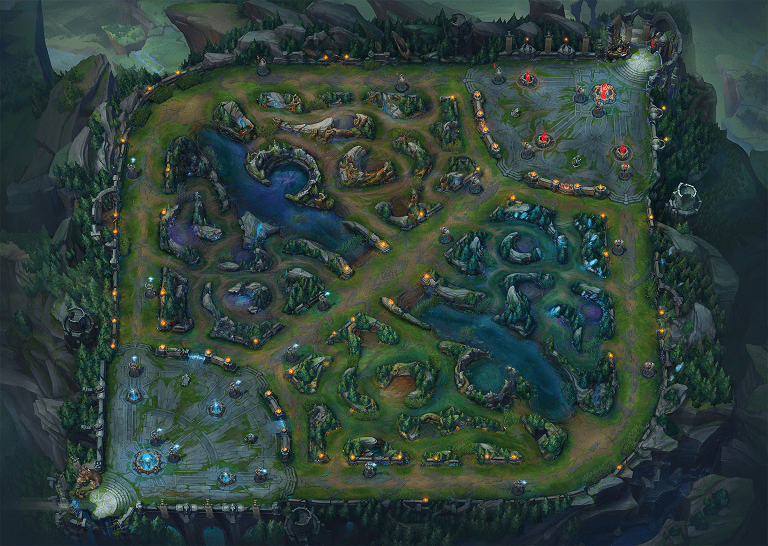
SummonersRift.png

Summoner’s Rift from League of Legends

For a prisoner’s dilemma MOBA modification, we could start with the same foundation. We would keep the two teams of 5 with their own bases that can be destroyed. We would also keep the idea of players gaining resources to improve their characters. However, instead of team AI spawning in waves to attack the opposing team, the AI would be an antagonistic third party that would spawn to the side and attack both teams. This AI team would scale in difficulty over time so that the players are pressured to gather resources efficiently. The longer a team survives, the more points they earn, and the final score would go to a leaderboard. If one team decided to steal resource from the other, they may survive longer and thus “win” the match, but they will score lower on the leaderboard than teams who cooperated. The variety of resource needs for each team should also be asymmetrical so that “trade” or “resource gathering permission” emerge in gameplay.

If players violate the peace by stealing from the other team or attacking, there need to be non-verbal tools for negotiation. A robust emote system to signal intent may suffice, but a global chat system could make cooperation too easy and introduce other problems.

While I believe this is a solution to the design problem, there are other faults. First, in this design, a “win-win” solution is still a “defeat”. Second, the mechanics are now too strict for generating a wider range of stories. As a result of these problems, I expect the game would have trouble retaining a playerbase.

Fuzzy Cooperation, but Cozy?
Another path to explore in the overlap of cooperation and competition is the idea of “cozy” design. In 2017, one Project Horseshoe report explored what it means to make a cozy game, and related research has looked into design patterns for friendship and the spectrum of player trust. To achieve the goals of these models, any competitive mechanic that can violate trust may come at too great a cost. It seems that this means swinging to the opposite side by adding competition into a cooperative game. But I think there is a way to add cozy cooperation as a subversive element within competitive games.

My early intuition here is to add features that function as “community gardens” do in real neighborhoods. Interactions with these “gardens” would persist across many multiplayer interactions and benefit other players. The garden would be a medium for giving gifts to the community, and for player expression.

An easier implementation: add toys to a competitive environment. Add a big trampoline in the middle, add a fishing pond, add a slip’n’slide. Let players opt out of competitive play if they want, and give them the tools to do so.

Other Examples?
I’ve had my head down in traditional multiplayer design, and I know I’m blind to some of the work going on in this space. However, there are a few recent examples that come to mind:

  • Destiny 2 is adding a new game mode called “Gambit” where two teams fight separate waves of enemies and have opportunities to invade the other team. This sounds like a horde mode with a little competitive play added in, but well have to see how it plays out.
  • Fallout 76 is online with a shared, persistent world of a dozen or so players. It is not strictly competitive or cooperative. It is also not clear how the game will police uncooperative behavior, or if it will have the same problems as Ultima Online.
  • One Hour One Life is a shared world multiplayer game by Jason Rohrer where players try to advance technology by working on the civilizations that outlive their characters.

Conclusion

There is potential for us to reach new audiences and tell new stories by moving away from traditional competition. As a multiplayer designer, I want to create better shared experiences (and create fewer experiences that encourage toxicity and hate). I think there is potential to achieve these goals in games designed around fuzzy cooperation and negotiation. There are also many problems to solve, but I hope this post has been a useful step forward.

Thanks for reading!

References:

All sources were retrieved July 4th, 2018

Early notes on level design playgrounds

In my work, I’ve started thinking of multiplayer level design in terms of public parks and playgrounds. I’ve found these metaphors useful while trying to integrate new design ideas—especially design patterns for friendship and trust—into older multiplayer design patterns.

So, on my flight back from GDC today, I took some time to think about actual public parks and playgrounds. Some principles:

  • Users can enter and leave a public park freely.
    • Most activities, like using a swing, are short instances with repetition. These activities do not lock users in for a long duration (social activities are more complex).
    • Some public parks offer walking trails, which can lock users in for a longer duration. When designed well, these longer activities offer rest breaks along the way and shortcuts back for those who need them.
  • The park and its resources are not depleted through use.
    • A playground’s toys and their potential for play persist between uses.
    • Some resources, like a bench or a swing, are “held” or “blocked” while in use. This requires turns and sharing when demand is high.
  • Playgrounds are fundamentally multiplayer (not fun when alone), supporting parallel play and cooperative play (like see saws and tire swings).
  • Good public parks give options for different kinds of users
    • The children can play on the playground while the parents talk on a nearby bench.
    • One user can walk through a garden while others play a sport in the fields.
    • In this way, the park is a foundation for many activities.
  • Excellent playgrounds offer the potential for “subversive” play, like walking up slides or devising other routes that feel unintended.
  • Playgrounds aren’t ashamed of being toys.

I then adapted these ideas to imagine an alternate reality to Doom (1993):

  • The game is fundamentally multiplayer, supporting opt-in competitive and cooperative play. Players can drop-in or out of servers as they please.
  • The level exit is available from the start. Some areas in the level require the player to backtrack some distance, but no areas lock the player into an activity.
  • No resources are required or consumed.
    • All doors can be opened and closed, and none require keys.
    • NPC Enemies all respawn, or “freeze” for a duration instead of dying.
    • Player also don’t have health, armor, or ammo to collect.
      • Without health or armor, this means that all incoming enemy attacks are limited to their audiovisual feedback.
    • Players can’t hoard weapons. Instead they may only use their current weapon, drop it, or swap it for another. There are no ammo limitations.
  • Combat areas are all opt-in, with safe areas available to take breaks.
  • A score, if it exists at all, is opt-in or player-controlled. The game does not dictate a correct way of playing.
  • The level offers a range of activities, making full use of exploding barrels and elevators and collapsing floors (so long as all reset for the next player).

This is a very different game!

In particular, removing combat attrition and resource management reduces the challenge of Doom. If a player’s goal is to spend all their time in a “flow” state (where their skill is met by the game’s challenge), then these changes gut Doom‘s depth. But in that exchange, this alternative Doom gains something. This Doom could be the place players meet on their way to other activities, or the place they go to relax and spend time in peaceful conversation.

I’m not sure what conclusions to draw from this, since my example is an extreme. I think some of these problems may be known within MMO design, though. Time to do more research!


The Red House of Sainte Marie du Mont

In 2017’s Call of Duty: WWII, the best multiplayer map is “Sainte Marie du Mont”, better known as “the one with the red house in the middle.” This level sticks to patterns we see across the other maps, but breaks them in a few ways to be more dynamic and memorable than its peers.

1-1-2018_11-14-47_PM.png
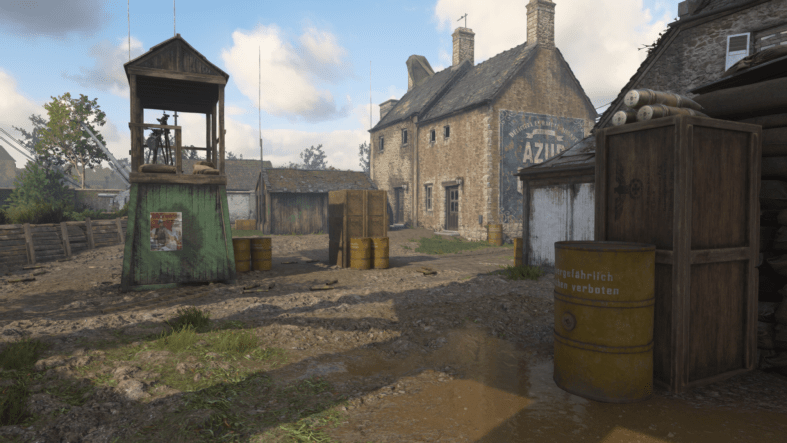
The “red house” in the middle of the map, as viewed from the Allied side

First for some background, the way I play Call of Duty affects the way I perceive the maps. Specifically, I play Hardcore Team Deathmatch where weapon are more deadly (one torso shot with a pistol can kill), and where there is no radar without a killstreak reward. I also play Call of Duty with my dad, whose reflexes (and ping) prevent us from executing fast strategies.

Here’s an overhead view of “Sainte Marie” pulled from the game’s UI:

SainteMarie.png

The formula for Call of Duty: WWII’s multiplayer maps is to have two spawn areas connected by three different routes. These routes then have lateral connections, which create loops, skirmish lines, and opportunities for flanking.

The two spawn structure of WWII levels also leads to spawn flipping. Specifically, there is some respawn logic that determines whether a spawn point is valid. The details of this logic are hidden to players, but it may include proximity to enemies or being within an enemy’s field of vision. The result of this respawn system with this level design is that if one team pushes across the map and starts fighting enemies as they emerge from their spawn, then the team spawn locations will swap, with the Axis now pushing north from the Allies spawn, and the Allies pushing south from the Axis spawn.

On some maps, including “Sainte Marie”, there are several spawn points in the middle, which come into play if the enemy team controls both spawn areas. These spawn points seem to have a lower priority, given that they are in more dangerous areas, so it is a bad sign when you spawn at one.

Additionally, because the only way to earn points in Team Deathmatch is with kills, and kills grant rewards that make it easier to earn additional kills, there is a slight feedback loop that lets the team in the lead extend their lead. On the losing side of one these feedback loops, this means you have to push harder and take more risks to regain a lead. On the other side, players can sit back watching from strong angles, and wait for enemies to step into the open. With Hardcore rules in particular, the player who moves around the corner will die to the player who was aiming at it.

1-1-2018_11-13-33_PM.png
Radio tower and one of the streets that form a skirmsh line across the map

As a function of these mechanics, one general strategy is to push forward past the middle of the map (but not so far as to cause the spawns to flip) and kill enemies as they sprint toward the middle of the map. Even after losing a fight from this forward position, both teams are on similar balance for the next fight, which will occur in the middle of the map. This strategy is only stable so long as teammates don’t cause the spawns to flip, which will mean enemies attacking from behind.

“Sainte Marie du Mont” varies this pattern from the other maps. Instead of an open arena in the middle like “Gibraltar”, or the open street in “Aachen” and “Ardennes Forest”,  “Sainte Marie” has a two story building with vantage points overlooking each side of the map. Players can still push past the middle building and fight from those angles instead, but the ability to defend this “red house” reduces the speed with which map control swings from one team to another. Defending red house slows the pace of the match.

1-1-2018_11-14-29_PM.png
Green tower, viewed from Allies side

But it is also possible to bypass the red house with the lanes to either side. If one team has locked down control of the house, the other team may be better off ignoring it and picking up kills in the flanks. The red house is also vulnerable to grenades, with its tight spaces and limited cover. In both of these ways, the red house can become a kind of noob trap. That is, everything about the level’s design and aesthetics suggests the red house is the most important location to control, but actually holding this house and fighting from its windows is less effective than fighting from an advanced position in the streets.

1-1-2018_11-17-02_PM.png
The interior second story of red house

In the best matches on “Saint Marie”, The red house is a pivot for control of the whole map. There are moments fighting from the red house, where it feels like I am clinging to the map and need to hold out long enough for my allies to respawn and reinforce. This scramble for control of one building has a thematic richness to it, and generates stories that are more compelling than any one moment of skillful play.

1-1-2018_11-16-20_PM.png
The first floor of the red house, and its dangerous staircase

Of course, there’s still something odd to me about a multiplayer game where players dress up in period-authentic uniforms and fire period-authentic weaponry to play something more akin to paintball than historical combat.

For more on that note, you should read Rob Zacny’s article on Watching History Fade Away in Call of Duty: WWII, and Cameron Kunzelman’s column on how The New ‘Battlefield 1’ DLC Demonstrates the Brutality of Multiplayer War


Halo and Inflexible PvP

I want to talk about some problems with player versus player games. In abstract, these problems are difficult to describe, so I want to talk about them through two matches of Halo multiplayer. These are matches where I played with a group of friends against unknown opponents through Halo’s matchmaking system. The specifics of these matches bring the problems of PvP into focus.

Derelict

Our first match was on “Derelict,” a two-tier octagonal map with a central tower and walkways connecting to an outer ring. Together, the tower and walkways occlude the lower floor into quadrants. The only routes up are through teleports, which deposit the player 45 degrees offset from their entrance, relative to the center. The teleport entrances and exits are in the open, with the best cover being the teleport itself.

DerelictMap
Green lines indicate teleport paths.

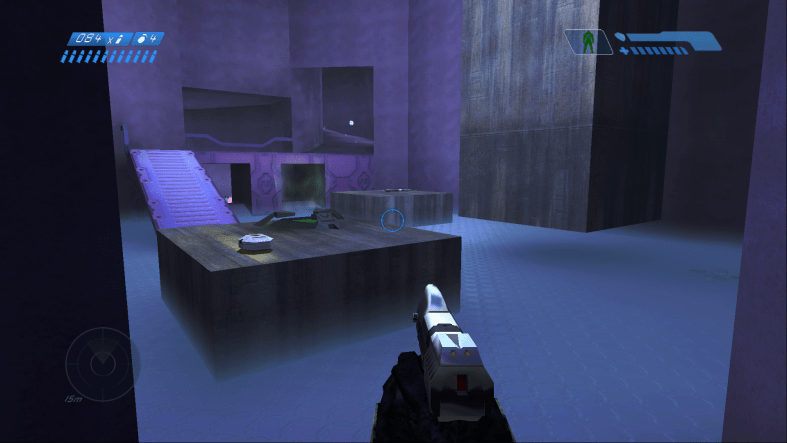
In the Team Slayer mode where kills equal points, all of the powerups spawn on the top floor. The overshield in the top center is the most important, and also the easiest to contest since the walls around it allow players on the bottom floor to bank grenades. Players who rush the teleports to the top floor have long sightlines down the walkways and past the overshield to the far side. In a coordinated attack, anyone by the overshield is doomed.

12-24-2017_7-03-05_PM.png
View from the top floor.

Most of the player respawn points are on the bottom floor, and Halo’s respawn system favors being near allies rather than away from enemies. This system means that once a team is all on the top floor, dead allies will respawn on the top floor. However, if anyone on a team is on the bottom floor, dead allies are likely to spawn there.

With the combination of the item placement and the respawn mechanics, the dominant strategy of “Derelict” is to control the top floor and kill the enemy players as they rush the teleports. Even in Team Slayer, “Derelict” plays like King of the Hill.

12-24-2017_7-58-51_PM.png
View from the bottom floor.

A final note before I get into the match’s specifics: in Halo, players spawn with an ineffective assault rifle equipped and have to switch to their secondary weapon, the pistol, to have a chance in a fight. This weapon swap means more than a second of vulnerability where the newly-spawned player can’t pressure an attacker to back off.

Altogether, these systems turn Team Slayer on “Derelict” into a grinding slog.

Match 1

In this specific match on “Derelict,” two of our four opponents dropped from the game within the first minute. By that time, my friends and I had started to control the top floor and the powerups. With only two opponents remaining, this imbalance guaranteed our map control, but this also slowed my team’s score per minute and drew out our inevitable win.

After this match, we looked up our opponents’ stats and saw that they were new players with only a few matches of experience. My team’s attempt to efficiently end the match (and get on to something better) may have spoiled Halo 1 to these players. But because there are no easy systems for communicating across teams in Halo, the entire experience was an anonymous cruelty.

When players are outnumbered in these situations, some choose to give up the match or “deny” it by preventing the other team from having fun. These players may set the controller down and walk away until the game ends as a passive rejection of the match. Or, in a more active rejection, they may kill their allies, jump off the map, or frag themselves on spawn. This behavior extends the game time, since it slows the rate at which the stronger team can score points, but it is a way for the losing team to control the pace of the game and reject the systems that put them there. Some of the behavior we commonly label toxic play or poor sportsmanship may stem from bad systems design.

Even on Halo’s best maps, 4v2 matches are common. In The Master Chief Collection, the queue for Team Slayer lets players vote on a random map from each game in the Halo trilogy, and the original Halo is divisive. Unlike Halo 2 and 3, Halo: CE’s levels are difficult to learn, which adds to the gap between experienced and new players. There are no maps like “Derelict” in Halo’s sequels. As soon as this skill and knowledge difference between the teams becomes apparent, the players on the losing team are stuck in a bad situation. If they leave too many games, they will face an automatic deserter penalty and may also face Xbox Live’s player reporting systems for desertion or bad sportsmanship.

As a player, it isn’t clear what many of these systems do. As a designer, it seems to me that the blame should fall on the systems that insisted a 4v2 match play to its end. Even before the match became a 4v2, the blame should fall on the matchmaking instead of the less experienced players. But there’s only so much that matchmaking algorithms can do on a small player population without dividing player parties. In designing these systems, we should ask ourselves who these systems are supposed to serve.

Longest

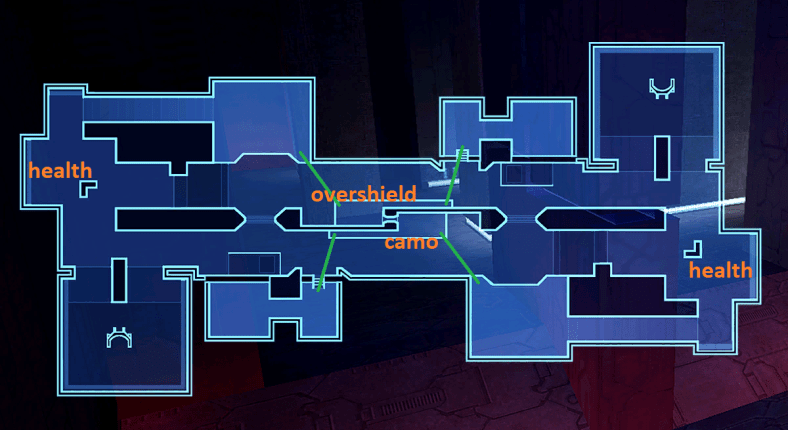
After this lopsided victory, our next match went to “Longest”, a small map with two parallel hallways and elevated rooms to either side. There are no rocket launchers or sniper rifles on “Longest”, but the standard grenades and pistols are more effective in the narrow gameplay space.

LongestMap.png
The green lines indicate jump routes between platforms on the second floor.

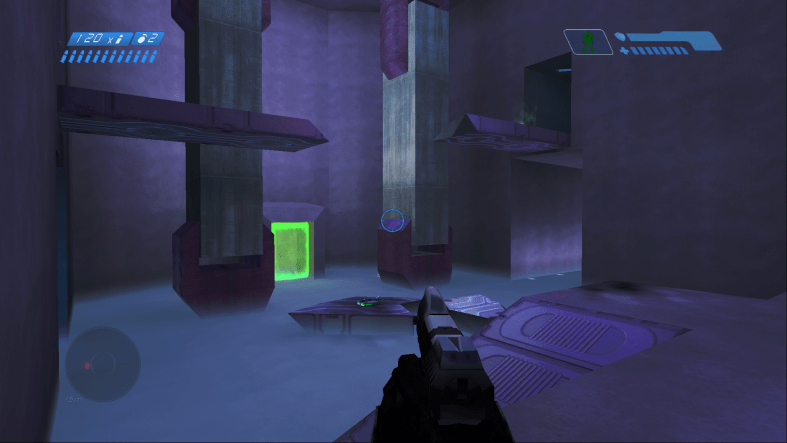
At either end of the hallways are a red and blue base, a health pack, and an enclosed ramp up to the second floor. These bases are where the players spawn. Aside from walking the long halls, the only other route is jumping across platforms on the second floor. Up here in the middle there is a powerup on either side, swapping between overshield and active camo after each use. This jump route is outside the lethal range of grenades on the floor below, but Halo’s floaty jump makes these players exposed to pistol fire.

12-24-2017_7-00-05_PM.png
A view from blue base down the hall toward red. The overshield is in the top center platform.

As a result of this structure, the map plays like a teeter-totter of balance swaps. At the start, both teams fight down the long hallways and push toward the far side. The team that wins the fight in the halls can continue the push into the enemy base, and if they kill all of their opponents there, the spawns will swap so that red team now spawns in blue base and blue now spawns in red. This spawn swap resets the fight, giving both teams a chance at a new push.

This spawn-swapping property, which emerges as an interaction of the level design and the respawn system, makes “Longest” more forgiving than a map like “Derelict”. Even after a bad start, the losing team on “Longest” has a chance to recover. The limited items also reduce how far ahead the winning team can be. The grenades and health items on the map are only useful to recover to the starting amount.

Match 2

Even though “Longest” is a more balanced map, our second match started much like our match on “Derelict”. Within the first minute, two of our opponents left. However, instead of another frustrating victory, I persuaded my teammates to stop shooting and to only use grenades and melee. The grenades are still effective, but players are limited to four, and must then find more grenades in the dangerous midfield, or must charge the enemies in melee combat. There is also friendly-fire, so our over-use of grenades turned the map into a hilarious chaos.

12-24-2017_7-53-43_PM.png
Red base, and an exploding grenade, for scale.

Despite our numbers advantage, by applying our own rule modifier, the opposing team was in the lead until the last few kills at which point we resumed standard play. Our opponents also appeared to join in on our grenade-happy shenanigans, with one of them scoring 10 grenade kills in the match. Most importantly, the opposing players remained active despite the odds, rather than turning to fun-denying strategies.

However, across the silent gulf of Xbox Live, I don’t know what our opponents thought, or if they recognized that we had changed the rules of the game to keep it fun. On our side, a few of my teammates saw the rule adaptation as a way to humiliate instead of merely win; perhaps this is how our opponents felt. Without means to communicate across teams, it is unclear whether our rule modification improved the situation.

Problems
1. Those with power in a match define its pace. Power here may mean having a numbers advantage, not just being the more skilled group of players. The responsibility falls on the dominant group to adapt their play for everyone’s enjoyment.

2. Reinforcing feedback loops or “snowballing” in level design, where the team that takes the lead can easily maintain it.

3. Rigid PvP systems that don’t match the players’ goals.

4. Rigid multiplayer that lacks communication tools for players to negotiate their goals and restructure the match.

Real World PvP
With each of these problems, we should compare the situation to real world player versus player games. That is, if we played this matchmade game on the greens of a public park, would we play the game to its end without modification? If not, then this is a case where the rigidity of a digital game’s multiplayer systems does not serve the players’ needs.

With these specific examples from Halo, imagine instead if the 8 of us were playing a game of soccer and two players had to leave. In the real world, the game is a servant to its players and will flex to accommodate their needs. The moment two players leave, the remaining 6 can decide if they want to continue with the game, and how they want to restructure the team if so. Or, if the match was more serious, the players can negotiate a rematch for the future.

In digital games, the rules are too often inflexible. There aren’t systems in Halo to negotiate a rule change part way through a match. This negotiation could include a mode change, or a team restructure. In both of the 4v2 matches above, Halo could have prompted a vote to make the game free for all, to scramble the teams, to end the match early, or to seek players to join in progress.

Existing Solutions?

  • Match join-in-progress. Depending on how quick the enemy team’s numbers can be refilled, and how much of a lead the winning team can take on the map, this solution may come too late to fix the problem. This approach works best where the server persists across multiple matches.
  • Player-controlled voting. In Counter-Strike’s casual servers, players can vote on a map change, on a team scramble, and on player kicking at any point. Most MOBAs let players vote to surrender. However, players can abuse these systems, whether or not the vote-calls are anonymous.

Other Solutions?

  • Discourage competitive motivations through the game mode design? Make the match about the kind of play that emerges in player versus player games instead of about winning. Treat PvP as a kind of cooperative play. (Regardless of how the game communicates this, competition is still a motivation players will bring to the game. There may be only so far we can push this solution.)
  • Matchmake by player intent, rather than skill? If a player signals that they don’t care about winning, prioritize matches with others in that category of play-motivation. (Depending on implementation, some players will find ways to abuse this.)
  • Add systems for nonverbal communication between teams? The first step of a negotiation between teams should be to identify and agree upon the problem. Acting upon that problem, such as a calling a vote, should follow from negotiation.
  • Let players leave casual matches without punishment. If too many games are ruined as a result of players leaving, then there are problems in other systems that we need to fix.

As a closing note, there is an experiment I want to run. In a game that is otherwise traditional PvP, I want to create an environment with no explicit goals or teams but provide tools and toys for various forms of play. This environment would have bases and flags, hills to be king over, as well as toys like exploding barrels and jump pads. This environment would allow players to set their character color mid-match to form teams. This environment would share voice chat across the entire group, allow the easy formation and dissolution of “team” communication channels, or use proximity-based communication. Better still, this environment would offer tools for players to communicate without relying on the disclosure of voice chat.

My hypothesis around this experiment is that we would see healthier player interaction, and we would see player needs rise in priority above competition. Ideally, this experiment would reduce the toxicity that drives players away from PvP gaming. However, it may also be that denying players’ competitive motivations through these systems reduces player engagement and retention.

This is an area I hope to investigate further in the future.

Thanks for reading!


Halo’s Multiplayer Maps and Public Parks

If you asked me to recommend the best public park in town, I would need to know what you want from a park. One park offers quiet walks through woods, but lacks open greens for a picnic or sport. Another has a playground for the kids, but lacks seating for parents and forces them into a hovering limbo. This same question is true in multiplayer level design. While a multiplayer game is live, the maps are like public parks to its players, and not everyone wants the same experience.

With this in mind, there’s a challenge in writing about multiplayer level design. In singleplayer, the standard structure is series of obstacles to overcome with a limited set of actions. From these patterns in singleplayer levels, we can talk about what a level does, and how variations in those patterns create meaning. But in multiplayer, the obstacles aren’t always designed or consistent, and the player’s goals may shift to keep the game interesting.

I want to talk about the first Halo’s multiplayer and its level design, but it requires some explanation.

A Background on Halo
If you aren’t familiar with Halo’s multiplayer, here are the basics: each player controls an armored super-soldier and sees through their character’s eyes. These players use sci-fi guns to fight and kill the other player characters. When a player character dies, they respawn in the environment after several seconds. (Because of the tight link between a player and their character in a first-person game, we use “player” to mean the character. This shorthand of “player” for “player character” creates odd conversations outside of gaming, like “I shot him in the head, but his grenade still blew me up!”)

The environments in Halo’s multiplayer are self-contained with varied vantage points, weapons, and powerups to affect player tactics and to encourage to take risks and move around the map.

If you are familiar with other FPS multiplayer games, the identity of Halo comes from its floaty movement and its shield mechanics. With the movement, players are slow at full speed and are slow to accelerate. Unlike Halo’s contemporaries on PC, when the player jumps, they can’t affect their velocity. The jump itself goes almost as high as the player character, and the jump lasts longer than it would in Earth’s gravity. This slow movement becomes predictable, which means easy to shoot, which means there are consequences for making a bad move during a fight.

With Halo’s shield mechanic, players take damage to a replenishing shield before they take damage to a health bar. A partially damaged shield will start regenerating after a second, and take up to a second to complete. If the player takes damage during that regeneration time, all of the shield timers reset. If the shield is completely destroyed, the player is vulnerable to headshots and must wait multiple seconds before the shield starts regenerating. Some weapons deal greater damage to shields than health. Other weapons deal enough damage to effectively bypass shields. In the first Halo specifically, the human pistol is overtuned: two headshots break an opponent’s shield, a third headshot is an instant kill.

This combination of mechanics makes standard Halo multiplayer about sustained precision and thoughtful movement. Tighter environments amplify these mechanics and introduce an aspect of map control and positioning that defined competitive Halo.

Local Multi-Play
Imagine it is 2001 and I’m playing Halo on a couch with three friends. We’re all kids, and when we decided to play, the goal was to determine the most skilled among us. But after a couple matches, the skill disparity is apparent and we start improvising new goals and rules. Melee only on the map “Wizard”, back-whacks worth 2 points, falling-whacks worth 3. Or maybe active camouflage and sniper rifles on the map “Sidewinder”. If a variant grows dull, we adapt it mid match and start shooting instead of using melee, or we start driving vehicles through the fields of invisible snipers. At this point, the group’s goal with all of these variants isn’t about who won, or who is the best. The variants are about adapting the rules, adding chaos and unpredictability so that even the weaker players have moments of success. If the variant instead aggravates the skill disparity, then a player may throw the match or break its rules; this kind of “trolling” behavior in local multiplayer is a way for a player to signal that they aren’t having fun.

This whole pattern of play is similar to how children on a playground will adapt tag into “freeze tag”, or “lava monster” (only the player who is “it” can touch the ground), or “metal monster” (the player who is “it” can only move around the structure where they are touching metal). This freeform play is not about winning or losing, and if the game locks into a solved state, where one player is stuck being “it”, the variant has failed and requires modification.

Now, if you asked me in 2001 to recommend the best map in Halo, I may have said “Wizard”. It has four sections of axial symmetry, two sets of linked teleports, a discrete first and second floor, and four powerups of two types. The teleports and symmetry create a kind of disorientation, which for casual play introduced chaos and puts a limit on tactical play. “Wizard” is also small enough that disorientation doesn’t matter; if the player picks a random direction and starts walking, they will find an opponent to fight. The map was also suitable to many of our game mode variants. “Wizard” was the go-to map for shotguns-only, or melee-only, or absurd infinite-grenade games. It also makes a great King of the Hill map, due to a central pillar structure that players can only reach by jumping.

“Chill Out” was another key map in the rotation for our local multiplayer, but its design has more nuance to it and has stuck in my memory longer.

The Structure of Chill Out
“Chill Out” is an interior environment where each room feels like a subtraction from a larger solid. There are now views out into the space beyond. The environment’s textures belong to the covenant alien art set, but the architecture has the harsher angles of forerunner architecture; even within the Halo universe, it is difficult to place where this map would exist. There is also a low, dense fog in the lowest part of the map, informing the players about their location. This fog gives a cold impression, playing off the pun in the map’s name.

ChillOutMap.png
Green lines indicate teleport paths.

Structurally, “Chill Out” has three sections, and six rooms.

Offset from the center, there is a four-sided room with two-floor, two elevated platforms on pillars where the rocket launcher spawns, and a long ramp leading from the bottom floor to the top. From this rocket room, the top door leads to a long, sharp-angled hall that exits at pink room; this hall also has a one-way teleport to shotgun room. A lower door leads to gold room, and a small curved door leads to the shotgun room. There are also two large archways and a space above them that connects rocket room to a lower room with a broken bridge.

12-2-2017_6-47-52_PM.png
Rocket Room. The door ahead leads to the shotgun room. Gold room is to the right, pink hall is above, and arches are to the left.

The bridge room has two wide halls on the lower floor connecting to the shotgun room and to gold room. The bridge doors connect to pink room on one side, and a spiral down to shotgun room on the other. Across the room there are two large pillars with a head-height gap to shoot through, and a one-way teleport up to pink room. Together, the rocket room and bridge room make up the middle section of the map.

bridge.png
Mid. The bridge to the right leads to spiral, and left leads to pink room. The lower hall on the right leads to shotgun room, and the left leads to gold room.

To one side of the middle section are pink room, gold room, and pink hall. Pink room is where the active camouflage powerup and the sniper rifle spawn. One exit from pink room is part of the broken bridge across the middle. The other exit is up a ramp and into pink hall to the top of rocket room, with a window looking down on gold room. The window in pink hall is too small to easily jump through, and the angle offers little to shoot at, but it is effective for throwing grenades. Pink room is also small enough to be susceptible to grenades.

PinkRoom.png
Looking into pink room from pink hall.

Gold room mostly functions as a connection between one of the long halls from mid to the bottom of rocket room, but it also has a one-way teleport to the broken bridge at spiral. This teleport is risky because the player exits facing toward pink room with their back exposed to anyone at the spiral from the shotgun room.

12-2-2017_6-43-50_PM.png
Looking into “Gold” room from the long hall. The door leads to rocket room.

The last section is the shotgun room and spiral ramp. This is where the overshield powerup spawns. whoever grabs it receives two extra layers of shield protection and a second of invulnerability on activation. Aside from the overshield, the shotgun room is a weak position. The shotgun itself is only beneficial in close combat, and the pistol starting weapon is more consistent across all of the map’s spaces.

shotgunRoom.png
Looking into shotgun room from rocket room.

From the spiral, a player may look across the broken bridge to pink, but the opponent in pink may have the sniper rifle. The spiral is also vulnerable to grenades. From shotgun there is also a small bend to the bottom of rocket room, but it has blind spots to three sides, including above it where the rocket launcher spawns. The only other exit from shotgun room is the other long hall into mid, which is vulnerable from the top of the arches. There is also a teleport exit from pink hall to the middle of shotgun room, which can lead to unexpected close-combat fights.

spiral.png
The view from spiral, while jumping.

Competitive Chill Out
In competitive 2v2 Team Slayer (a game mode where kills convert to points), the effect of this design is that both teams attempt to control rocket room and pink room. While players are in these rooms, the game blocks enemies from respawning nearby, which increases the likelihood they respawn in bottom mid or in shotgun room. From this setup, the team in control times pushes into the shotgun room with the overshield powerup’s respawn. For a team trapped in the shotgun room, the overshield is the best way push the enemy team and regain map positioning.

12-2-2017_6-48-43_PM.png
The view from pink room.

If both teams are equally skilled, it is difficult to maintain this or any other setup. In 2v2s in particular, when one player dies, the other needs to move or risk facing a 2v1. Because of these power shifts, both teams must keep rotating between strong locations on the map. Some of these positions are about information more than the damage a player could deal from them. For example, at the door to the bridge from pink room, a player can see two exits from shotgun room and a clear view across rocket room, but not all at once without stepping out onto the bridge. Two of these views are too narrow to hit a running enemy more than once, yet it is a valuable position for spotting enemies. In this way, information control is linked to map control.

With competitive play, we can also think of each action a player takes as an exchange of resources. A player may exchange shield and health for a better position when they take fire, or a player may exchange a good position to get a powerup or weapon. Strong positions are those with many options with good exchange rates. Weak positions and “traps” are those where every option becomes a risk.

Other Aspects of Chill Out
For couch multiplayer, this isn’t how “Chill Out” plays. For us playing in 2001, “Chill Out” was less of a coherent playfield than a funnel for conflict and surprise.

Doors, Halls, Teleports
All of the door and hallways on “Chill Out” are long and narrow. Some doors are as long as they are wide, blurring the definition between a hall and a door. In the tightest of these spaces, a player can’t juke an enemy’s aim or avoid grenades. Some of the ceilings are so low that a player will bump their head if they jump. Due to this, a player can delay an enemy push or force a retreat by throwing a grenade into these hallways and doors. These structures also force a harder commitment than doorways in tactical shooters. The shield mechanics and their requirement for sustained precision in combat mean that a player must commit to entering an arena rather than poking ineffectually from the far side of a door.

bigdoor
Big door from Gold to Rocket creates big blindspots.

lowhall.png
Long hall from overshield spawn, through mid, to gold room

The map’s one-way teleports also function as a kind of doorway, but they force an even harder commitment than actual doors. In casual play, where there is too much chaos to predict the game state on the other side of the map, the teleports are like a die roll: an enemy may be camping the exit, or the player may catch their enemy off guard. As a new or infrequent player, it is hard to even remember which teleport goes where, which can be a source of surprise and even humor in the gameplay.

The teleports are also a way to escape fights, since it is not possible to shoot or throw grenades through them. Whoever enters the teleport first can step back, wait for their opponent to chase, and strike them with a melee attack. Or, the player can bounce a grenade off the teleport entrance as they walk through it, discouraging enemies from continuing the chase.

Friction
One tenet of current game design is to limit the “friction” or “rough edges” that players encounter. One form of friction is to test boring skills. For example, crossing the bridge from pink room to spiral requires a careful jump, and timing it incorrectly means barely missing and falling into the open at bottom mid. There is a similar jump to the rocket platform, and another to the top of arches. These are frustrating skill checks because there is no partial failure state or room for recovery. The punishment of a slow, predictable fall from these failed jumps makes them even worse.

There are also broken chunks of the bridge on the ground of bottom mid. Although these add visual interest to an otherwise abstract map, they add literal friction to the play space. An inexperienced or distracted player trying to cross bottom mid will not realize what they are stuck on without looking down or jumping blindly, both of which cost time and may get the player killed.

We could also include the narrow hallways and low ceilings as sources of friction. These spaces feel uncomfortable. But fixing these areas, as Halo 3 did in its “Cold Storage” remaster of “Chill Out”, removes something from the heart of the map.

Closing Notes
There are a lot of aspects to “Chill Out”, or a lot of ways to view it. So, how do we talk about multiplayer level design? Is “Chill Out” good or bad? Is it a dog park to someone who wants a quiet stroll, or a playground to someone without kids?

We can list all the ways in which players play a map. We can divide a map into its components, describe their interrelations, and consider how each piece affects various players. Or we can take a narrative approach and tell stories of our times in these spaces. None of these approaches seem to fully reveal the heart of a map. But, inherently, isn’t that because a good map, like a good public park, should mean many things to many people?