Quake’s Moats and Bridges

Throughout the first episode of Quake, there are moats and bridges. Each has varied mechanical functions, depending on the level. Thematically, what separates a bridge and moat from similar structures like catwalks across hazards is that they functions as a threshold the player must cross. At their best, these thresholds signify a first step in an attack against an enemy stronghold. This frames the player’s actions within the fantasy of storming a castle, which gives the player unspoken goals: get to the heart of the fortress and take it.

Compared to other level starts in Quake and in Doom, the bridge and moat setup offers better context for exploration and combat. Keep in mind that as we go through some of the examples from this episode, not all have equal impact, and players may experience these areas differently than I describe.  This is because the effect of this motif depends on level design working with game design and drawing from a player’s cultural awareness. This is not a fundamental property of bridges everywhere. With a different set of verbs, such as the cleaning verbs of Viscera Cleanup Detail, players could have different reactions to identical level design.

This is also just one motif we can look at with Quake. We could find even more riches by considering the design of the keys and locked doors, or by looking at how the game introduces each new enemy, or by studying each trap the levels springs. For a 21 year old game, there is still so much to learn from its design!

E1M1: Slipgate Complex by John Romero
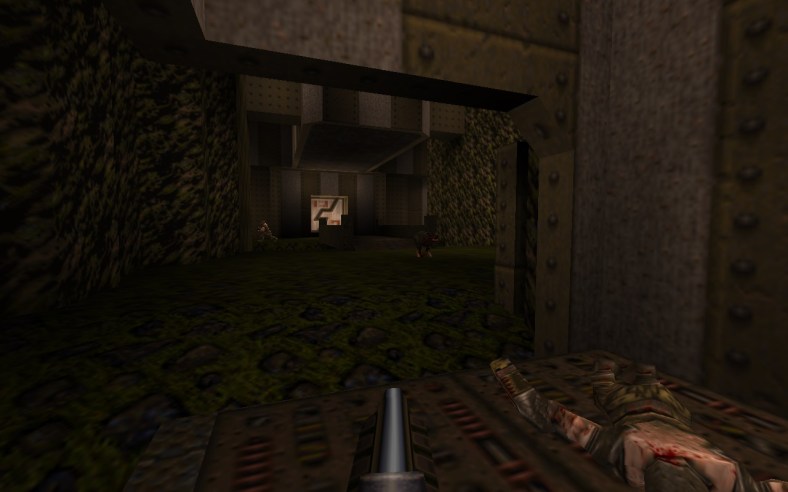
We experience the first moat and bridge after descending an elevator from an enclosed tech base art set. Due to the orientation of the button in the elevator, the player will be looking to the left of the bridge and will hear the enemies before seeing them.
E1M1_1
First glance of the moat and bridge in E1M1

Turning right to face the alerted enemies, the player sees the moat and bridge in the middle of a box canyon with organic green and brown tones in their textures. Across the moat the player sees another tech base and also sees the alerted enemies.

From gameplay, the moat functions as a funnel for navigation. We are able to see our enemies and predict their path to us. The moat in this box canyon environment lets the player cull extraneous information and focus ahead on the enemies.
E1M1_4.jpg
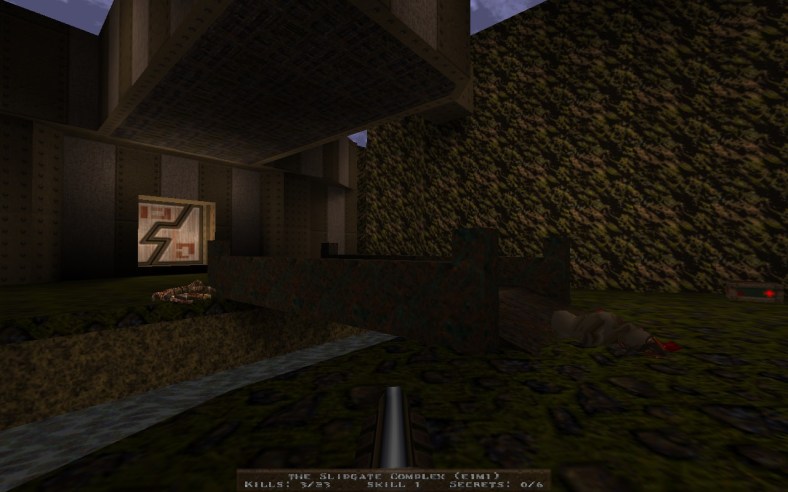
The moat and bridge up close

One of the enemies is a Rottweiler, which we hear bark into its alert state. Because the Rottweiler melees, it crosses the bridge immediately to enter attack range. The bridge has railings along the side which partially obscures the Rottweiler and prevents a direct attack. The other enemy is a grunt with a slow shotgun attack, which can hit the player across the moat. The player only has a shotgun at this point, which has a slow refire rate and is less effective at range. If the player chooses to shoot at the Grunt as the Rottweiler crosses, the player may not have time to respond to the Rottweiler before taking damage, and the Grunt will still be alive. As the second space of the first level, this moat and bridge introduce the player to target priority, which is a recurring theme of Quake’s combat design. The level reinforces this idea in the next room where the player faces several Grunts, a Rottweiler, and an explosive barrel.

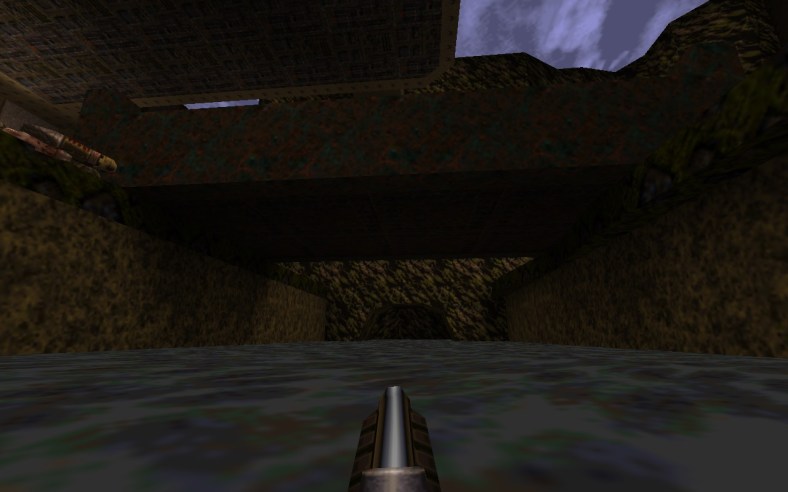
This moat and bridge also introduce the player to their first secret area. If the player is still becoming familiar with the controls of a 3D First Person Shooter, there’s a good chance of falling into the moat, and the only way out is through a secret area with a reward. Players who are familiar with 3D first person controls should also notice the secret easily. Either way, discovering this secret tells the player about the way the levels are structured, and that there are rewards for exploration.
E1M1_2.jpg
Walking in the moat in E1M1

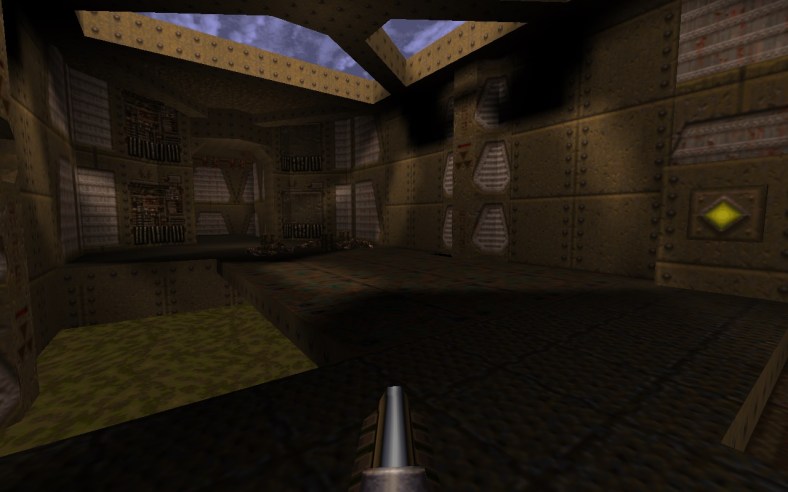
Deeper into the second compound we see a second moat and several Grunts across from it. The water in this moat is a putrid green and will damage the player. There isn’t a bridge until the player presses a button, at which point it slides out and any living enemies will start crossing. This setup does not serve the same thematic function as the first moat and bridge, but mechanically it is part of a conversation the level is having with the player. Both moats serve a similar role to the pits players must jump at the end of Super Mario Bros 1-1. The first obstacle teaches the player in a safe environment. The second obstacle teaches the player with a risk. From then on, the levels use this established pattern as a building block for more complicated setups.
E1M1_3.jpg

E1M2: Castle of the Damned by Tim Willits
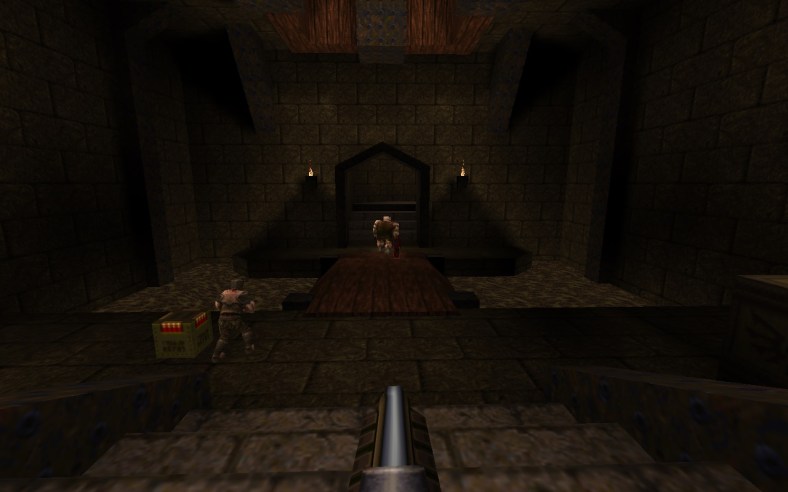
As soon as the player starts the level, they see they are in a room with a Grunt and an Ogre facing toward a large doorway. On the far side of the room is a moat of dirty water and a wooden bridge that the Ogre is crossing. As a way of introducing this new enemy, the level lets the player decide what to prioritize and when to start the fight. If the player waits, the Ogre will continue its patrol out the door, up some stairs, and around a corner out of sight.
E1M2_1.jpg

The player also starts on a higher platform from the two enemies. If the player immediately enters combat, they will have the advantage. Specifically, the Ogre enemy fires a projectile grenade that bounces several times before exploding, or will explode on direct contact with the player. Because the Ogre is on the low ground, he may miss, hit the edge of a stair step, and cause the grenade to bounce back toward himself. This setup is the safest way to fight an Ogre.

Visually, the environment reads as an old castle or dungeon. If the player stops to study the architecture, it doesn’t make sense as a real castle. Since the player is in a room that is presumably inside the castle, it makes no sense to have a moat and bridge here. There is no apparent water source or drain. In short, this moat and bridge fails the “who built this?” “Why would they build it this way?” and “What happened here since it was built?” questions we expect most modern AAA games to answer.

However, for the experience of Quake, answering these questions does not matter. The level wears the skin of an old castle, much as sections of a themepark wear their facades, or as dreams recreate just enough familiarity for us to see them as real. If we transplanted the game mechanics of Thief, then a kind of architectural semi-realism would matter more because the player would need to recognize rooms by their function (bedroom, kitchen, parlor) and recognize the value of loot associated with those locations. Realism for these games only matters to the degree it serves the whole experience, and for Quake that means spooky, dream-like castles and dungeons, not real ones.

Returning to the moat and bridge, since this is only the second level there is still a good chance the player may fall in by accident as they learn the controls. The bridge itself has ramps into the water that allow the player to easily walk back up. Although the water is dirty instead of a clean blue, the player does not take damage. Unlike the first moat of E1M1, the water here is deep enough that the player must swim. There is only real danger if the player falls into the moat before killing the Ogre. The Ogre’s grenades sink, and the Ogre will block the exit from the water where the player must enter range of its chainsaw melee.

For players who discovered the secret in E1M1, E1M2 offers a subtle callback. As with the first moat and bridge, there is a secret to the right. With E1M2, players must shoot the wall to discover it, and there are no hints other than knowledge from the previous level.

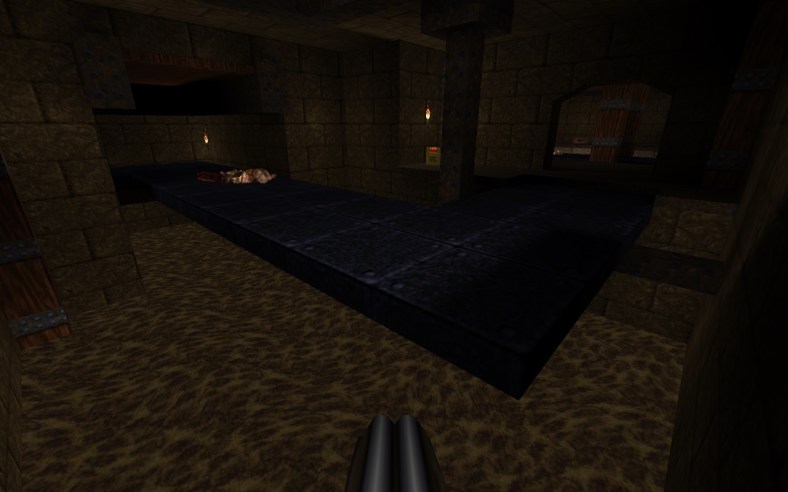
Moving deeper into E1M2, there is a large room with several balconies, a large pool of dirty water beneath it, and a catwalk crossing to the far side. This space functions more as a combat encounter, or a room that players inhabit for a duration, rather than the threshold function of the moat and bridge. There are many other spaces in Quake with extended catwalks and hazards to either side, but they operate as a separate motif from the moat and bridge.
E1M2_2.jpg
One of the catwalk and hazard setups in E1M2

E1M3: The Necropolis by Tim Willits
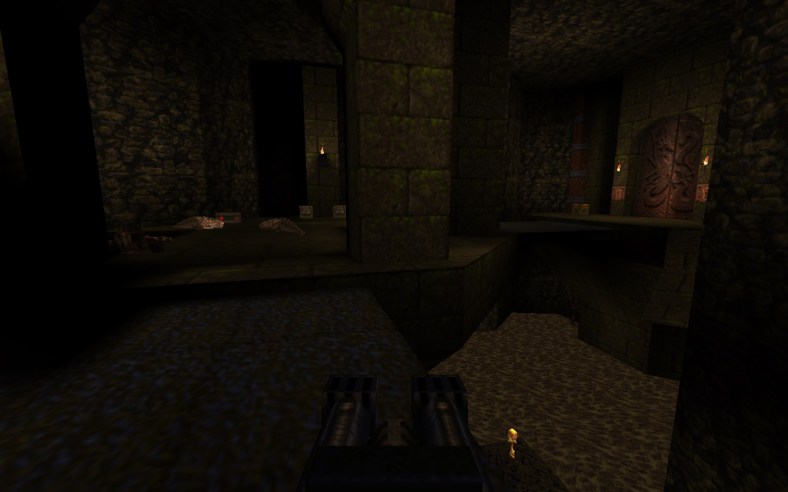
In the third level, after the first few areas of combat and an introduction to a new weapon and some new enemies, the level presents us with a really neat setup. This is one that blurs the boundary between my definitions of bridge and moat versus catwalks and hazards. Here we have a bridge extending to a tower, which has another bridge extending to a platform with a gold door. Below these bridges, instead of a moat we have a large room with water, and the player can see the gold key on a patch of dry land.
E1M3_2.jpg

This setup informs the player about their goal (the locked door), and about one of the steps to achieve that goal (the gold key). From here, the player’s navigation through the level has context. Even if the player loses track of where to go, as they might if they jump into the pit for the gold key, the larger goal gives some direction. If, for example, the player jumped into the pit and found a staircase leading down and another staircase leading up, the player understands they must return up to complete the level, and can assume that the staircase down is toward a secret instead.

E1M4: The Grisly Grotto by Tim Willits
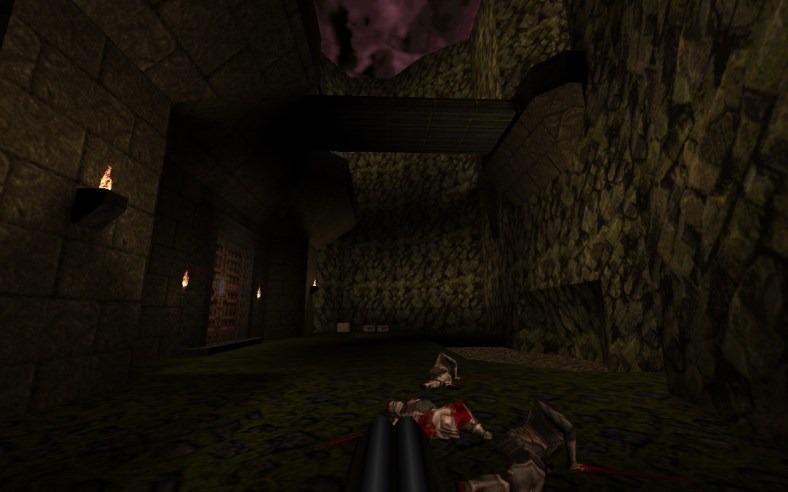
At the end of E1M4 we get a fun reversal of the moat and bridge motif. With the other occurrences up to this point, killing the bridge guards and crossing it are the first steps into enemy territory. With E1M4, the bridge is the last step of a map. The player leaves a castle-like structure to cross a bridge to an organic gap in the cliff side. This setup is as if the start and end of the level were reversed, or as if the player is finally exiting the back of the castle that they entered in E1M2.
E1M4_1.jpg

E1M5: Gloom Keep by Tim Willits
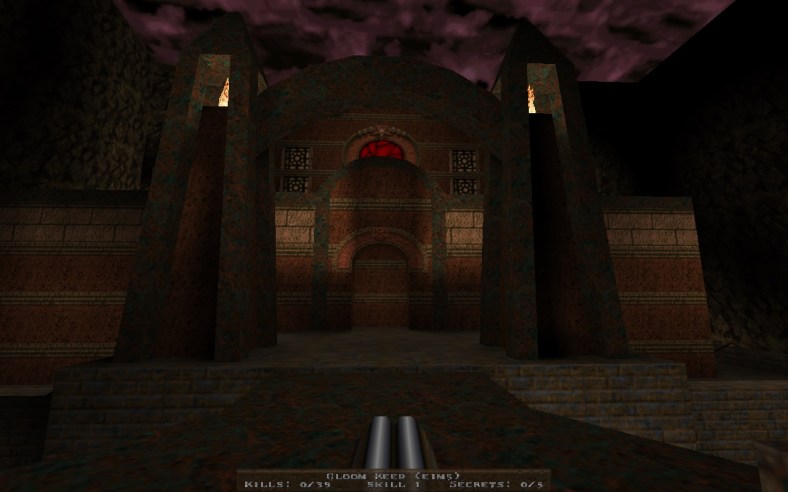
This is the most obvious moat and bridge setup of this episode. Immediately on entering the level, the player sees a huge fortress, a front door framed by two massive pillars, and the bridge itself.
E1M5_1.jpg

Where this use of the moat and bridge falters is that that the player starts on the bridge. The player does not get to decide if it is time to cross and do battle, as the player did in E1M1 and E1M2. This weakens the alignment between the player’s actions and the theme of storming the castle. This setup also reduces the possibility to anticipate the fight ahead

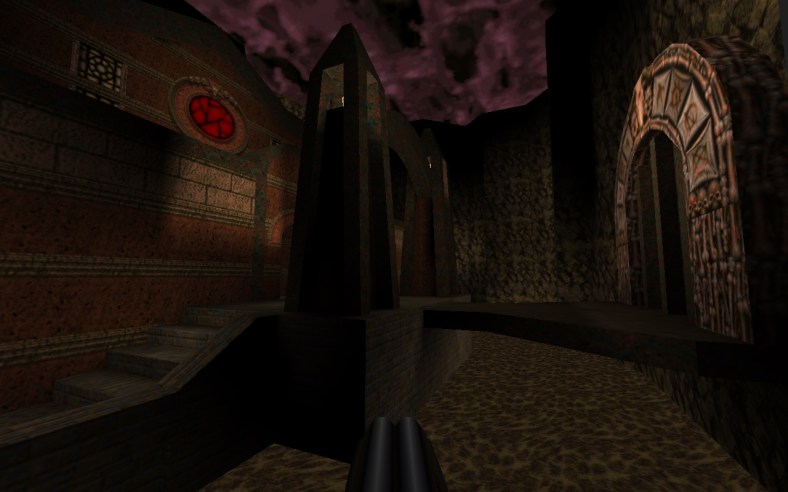
Aside from this, the setup is familiar. If players fall of the bridge, the water is safe and will lead around to a side entrance in the castle. If the player swims underwater to the right of the bridge, they will find a secret cave with a health item as a reward.
E1M5_2.jpg

E1M5 also is the last level in the episode with a moat and bridge…

E1M6: The Door to Cthon by American McGee
But I can’t talk about Quake episode 1 without talking about E1M6! This is my favorite level in the game. Like McGee’s E4M1 in Ultimate Doom, this is a combat puzzle box where the player teases at various pieces to see what unlocks and what new traps will spring.
E1M6_1.jpg
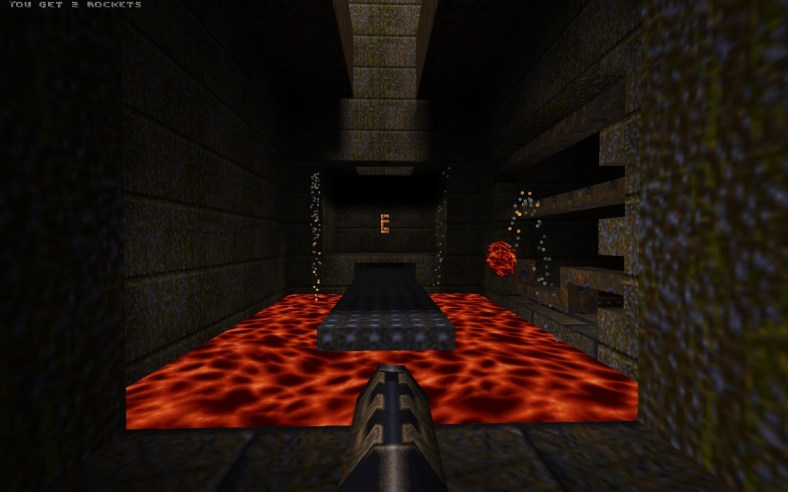
Definitely not a moat and bridge?

E1M6 doesn’t have the moat and bridge motif, though, unless we count this diving board platform to reach the gold key? No? I guess I’ll have to save discussion of that one for another time.

Thanks for joining me on this look at one facet of the design in Quake’s first episode.

Cheers,
Andrew

Correction: previous version incorrectly credited E1M5 to John Romero, instead of Tim Willits. Fixed 11/24/2017 9:55pm

 

Towards Better Cooperative Play

Let me share my best cooperative gaming experience:

My friend and I had decided to replay Halo: Combat Evolved on the hardest difficulty, as we have many times before. This time we played cooperatively online from New York to Georgia, both of us away from our hometown on the west coast. For the first few missions, the game was an excuse for talking about our lives and catching up, interrupting a topic whenever the combat became difficult. As the session progressed, I started to observe our different play styles and preferences, and how that affected our cooperation. As we began mission seven “The Library”—known for its long fights from all sides against the zombie-like Flood enemies in repetitive corridors—I decided to act on my observations about our preferences. For the length of the mission, I would be my friend’s bodyguard and prioritize keeping him alive. I kept this goal secret so it wouldn’t affect my friend’s behavior. Achieving this goal meant keeping coms clear and relying on shorthand callouts adapted from our time playing against other people. More importantly, this meant holding a model of his status in my mind: his position and direction, his health and shields, his weapons and ammo. When I saw him turn one way, I swept my aim to watch his back. When he took point down a corridor, I backpedaled while covering the rear. When I found health packs or weapons, I checked if he needed them more than I did. At the most frantic moments, we became a swirling dance of monster-killing efficiency.

There is a version of this cooperation that could have been condescending, like a parent in “tryhard mode” with their child. If I had perfected my goal of guarding my friend, he would have had nothing to do. I would have made the game boring for him, or worse, I would been selfish by “kill stealing” from him. Because of the difficulty in “The Library” and the difficulty maintaining the model of my friend’s status, the game remained challenging for both of us.

My goal was also more subtle than playing bodyguard, but it is the most accurate term I can find. When I found a rocket launcher, I asked him if he wanted it (despite the danger that comes with explosives in close combat). Or when we approached a tunnel too narrow for us to walk abreast, I asked if he wanted to take point while I covered behind. In these cases, I was a bad bodyguard for the sake of his fun.

Most cooperative play tends to mean parallel solo-play or turn-taking. These are cases where players affect a shared game state but have limited interaction together. Until “The Library”, most of the Halo playthrough with my friend had been parallel solo-play with some turn-taking. That is, we could have ran two separate singleplayer games while talking to each other and had an equivalent experience. In missions with multiplayer vehicles, we took turns driving. Or when we found power weapons on the map that we both wanted, we would take turns based on who took the last power weapon.

Some games try to solve this parallel solo-play problem through character specialization. The thinking is that if every player has a specific role, and each role must succeed for the team to succeed, then the game requires teamwork; harder challenges require more teamwork, which requires team building. The most common example is the trinity of tank, healer, and damage. Tanks draw the focus of enemies, healers keep their tanks alive, and damage kills the enemies. Through varied design, this calls for some synchronicity between players. For example, if the tank receives a huge burst of damage, the healer must react before the tank dies. Even though players’ actions affect each other’s success, this gameplay is still more of a parallel solo-play than cooperative play because there is limited reciprocity. The most frequent and important actions go one-direction.

This creates real problems in class-specialized player-vs-player games, especially for support players. A good support player keeps their tanks alive while they battle for control of objectives, but it is harder to credit their contribution to the team compared to roles that have metrics like kills or objectives captured. To make things worse, players have incomplete knowledge in realtime, avatar-based action games. A players can’t always know when they are a lower priority for healing than another player, or when they are positioned where the healer would need to take unjustifiable risks. This leads to increasingly bitter cries of “need healing!” To remain balanced, support classes have to deal less damage and have less health than other characters, which leaves them vulnerable to flankers and can mean a negative kill:death ratio. In worst designed cases, healing feels like a chore. With all of these factors combined, support tends to get all the blame and none of the glory.[1]

If we ported the designed healer-tank interaction to a real relationship, we would call it unhealthy for its imbalance. Nobody in a relationship should give all of their attention to a partner who doesn’t reciprocate attention or energy. But in the game-equivalent, players are expected to fill these designed roles to win. This design is especially problematic with how it links to gender expectations. Supports are often female characters with maternal qualities, and tanks are often hyper-masculine men, playing off traditional gender roles and the separation of public and private spheres in sayings like “behind every successful man [tank] there is a woman [healer]”. In male-dominated gaming communities, healer roles are often called the easy-to-play (read: boring) girlfriend role.[2]

Part of what separates the type of cooperative play I described at the start from these problematic forms is the amount of reciprocity between players. The first part of reciprocity requires one player to observe the status of another and act upon that information. For the loop to complete, the other player must realize they were affected and respond. Reciprocity fails when players have limited tools for observing player status, for acting upon that observation, for realizing they were affected, or for responding. We can think of reciprocity as an exchange of some resource, including time or attention. The amount of reciprocity depends on the degree and frequency of the exchanges. On one end, checking my teammate’s status could start a short reciprocal loop so long as my teammate knows that I am checking on them. On the other end, giving an expensive gift could begin a slower reciprocal loop to build trust and friendship.[3]

Returning to Halo, my cooperative experience at “The Library” stands out because its difficulty encouraged small but frequent reciprocal actions. At the most basic, surving “The Library” means coordinating movement and shooting, which requires players checking on each other and acting on that information. Not all of these actions are observed and reciprocated, but they are frequent enough that not all of them need to be. Such a high level of coordination was only possible while maintaining a rough model of my friend’s status because of hidden and imperfect knowledge in Halo. When I look at my friend’s character, I know what direction he is moving, where he is looking, what weapon he has equipped, and whether he is taking damage. I can start a basic model from this information, which lets me look away for several seconds and know that I won’t step into my friend’s field of fire or be shot in the back by enemies. The other status information like shields, health, ammo, and secondary weapon require communication to maintain, or rough approximations. With such a burden of information, it is no wonder that these moments are rare.

How could we redesigned Halo to reduce that burden?

  • Add your partner’s status to the UI, either as part of the HUD or pinned to the character model.
  • Reduce the amount of information by cutting design. For example:
    • Limit players to one weapon and remove ammo limitations.
    • Change the health system to recharge instead of requiring a shared, limited resource.
    • Improve the UI for indicating the distance to allies so that players can act without having to look.
    • Add dynamic “chatter” for the player-characters to call out enemies and status changes on behalf of the players.

Many of these systems exist in games created since Halo. Each come with costs to the core design and to production. Worse, many of them break the reciprocity loops by hiding the interaction! (Or perhaps, once this burden is removed, players are free to engage in higher-level strategy?)

If our goal is to add more reciprocity loops to Halo, or improve the existing loops, what design changes could we make?

  • Replace the flashlight with a waypoint marker. That marker could change based on the context, whether it’s an enemy, an item, an objective, or a beautiful view that a friend wants to share.[4]
  • Change the weapon and ammo system to a shared inventory so that one player could pick up a item for another.
  • Or add the ability to drop weapons or give ammo.[5]
  • Remove environmental health packs and give each player a line-of-sight heal ability on a short cooldown.[6]
  • Redesign mission objectives from “kill everything” and “get to the end” to “perform two separate actions simultaneously, or in a mutually-dependent sequence”.
  • Add enemies that force cooperative responses.[7]

Most of these ideas would make Halo a different game, and a bunch of unpredictable design problems would follow as a result. I have a sense these rough ideas would lead somewhere, but I would need to test them before I can say for sure.

Some notes for future research:

  • Skill-checks as a lens for thinking about whether a design encourages cooperative play.
  • Hypothesis that building trust between players requires the potential for failure or exploitation. How can we do this safely in online communities?
  • In games where player-characters improve, how do we avoid false stratification between players?
  • Hypothesis that decreasing stakes and urgency in casual player-vs-player games will reduce toxicity.
  • Can we, and should we, design around player skill gaps in cooperative play?


Notes, Further Reading:

[1] Philippa Warr gives a specific example through Overwatch‘s play-of-the-game system: https://www.rockpapershotgun.com/2016/05/31/overwatch-play-of-the-game/

[2] writes about supports in Overwatch as part of the bigger problem of unrecognized emotional labor: https://killscreen.com/themeta/overwatch-problem-caring-labor/

[3] A report from Project Horseshoe on game systems for building friendship between players: http://www.lostgarden.com/2017/01/game-design-patterns-for-building.html

[4] Some large multiplayer games like Battlefield and Rising Storm have scouting mechanics where players can tag enemies. However, with so many players, it is hard to tell who did the scouting, which makes it less valuable as a callout clarification.

[5] Dropping weapons during the buy-phase is an critical team interaction in the Counter-Strike series.

[6] Left 4 Dead and Left 4 Dead 2 have team-healing mechanics, but they come at a time expense to discourage healing during combat, and a resource expense that makes it infrequent.

[7] Left 4 Dead and Left 4 Dead 2 do this through enemy types that pin or stun the player until their teammates help.

Notes on Strafe

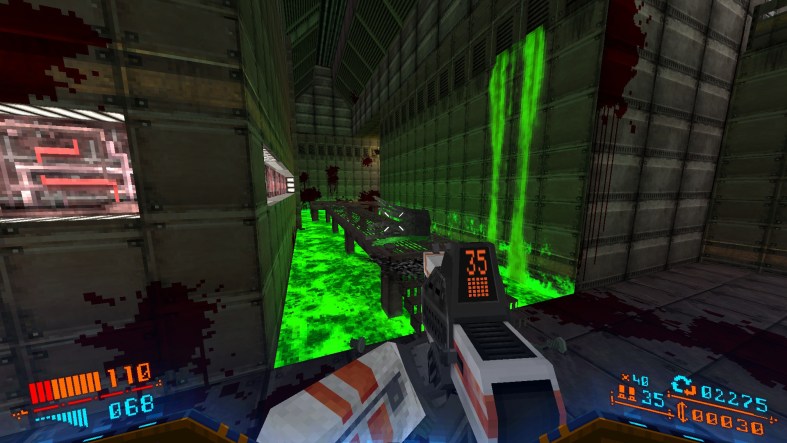
Earlier this month, Strafe came out. It styles itself as a first-person-shooter in the tradition of Doom and Quake. The tagline even places it in the year of Quake‘s release: “Bleeding Edge Graphics and Gameplay (C)1996”. Strafe falls short of that goal. There are bugs and framerate problems, but there are also design problems that I think are worth dissecting.

In case you aren’t familiar with Strafe, here’s the launch trailer:

Skill Checks and Loops

When I want to understand what a mechanics-driven game is about, I look at the skills it checks and how it checks them. Generally, “skill check” is a term from tabletop RPGs where a gamemaster asks a player to roll some dice based on their avatar’s skill and determine where the action falls between success and failure. For digital games, if we think of the designers as the gamemaster, then by asking what kind of skills the gamemaster checks, we can determine what kind of game they want to run.

We can also think about the player’s actions and skills as part of several layers, or loops, based on how frequently each occur. The first loop is second-to-second decision-making that players internalize as they learn the game’s mechanics. The second loop is minute-to-minute decision-making, which can also become habit through practice. Additional loops can exist for session-to-session or hour-to-hour.

(Mind that this framework doesn’t work for all games, especially those with narrative focus.)

Skills in Strafe

The first loop is about surviving second-to-second gamepaly. The skills in this loop build on each other, and as players internalizes these skills they can shift conscious attention to higher-order skills.¹

  1. Controls and input: moving and shooting in 3D environments
  2. Kiting: moving through safe parts of the map with enemies chasing out of reach, like pulling a kite by the string. (Because most enemies in Strafe are melee, players can kite large groups and clear them without taking damage.)
  3. Seeing the signal in the noise: identifying acid pools, fires, enemy projectiles, and enemies against the environments and debris.
  4. Map knowledge: avoiding dead ends or unsafe territory while kiting enemies.
  5. Target prioritization: identifying the enemies that pose the greatest threat, and changing position or weapons to kill them or change the priority.

As the player gains mastery of the first loop, they begin learning the second loop of skills required to survive the minute-to-minute gameplay.

  1. Resource management and exchange: players can spend scrap to buy ammo and armor, but players can also “spend” health to preserve ammo and gain positioning, or spend ammo to preserve health or shields. Players can also spend scrap for credits, which players use for items, which in theory help the player preserve health or ammo.
  2. Signal and Noise during map exploration: identifying resources among the gore and trash is an essential optimization.

The third loop for Strafe is session-to-session, trying to beat the game. With this goal in mind, there are ways to activate teleporters at the start of each zone and skip to them at the start of the next run. This serves as a partial success state, or a checkpoint toward the larger goal. Spelunky has the same logic for its zones. Even if a player knows they will fail their run, possibly due to bad luck or a few errors, this gives them a reason to continue.

At least that appears to be the design intent. In practice, it is unclear what steps are necessary to fully repair any of the teleporters. Skipping ahead also limits the number of powerups and items a player could earn in a run, which makes the boss more difficult.

Strafe_01

Based on the global Steam Achievements, this third loop is not successful. More people have completed the game without teleporters than have fixed the teleport in zone 2. (The achievements for fixing the teleporters in zone 3 and 4 are at 1.5% and 0.5% respectively.)

Bad Skill Checks

One way that skill checks fail is when there is a consistent, repeatable solution. This becomes boring quickly if there aren’t other challenges for the player. And when the skills in the first loop become boring, the second and third loop are often insufficient to keep the player playing.

If the goal is to create a game that players spend a long time playing, one solution is to add depth by improving the existing skill set. (To mix metaphors, raising the skill ceiling adds depth.) The other solution is to expand the low-level skills by adding more variety and ensuring more permutations.

In Strafe, combat has the same solution for most enemies and levels: eliminate ranged and acid enemies first, then safely clear melee enemies while kiting them. The level segments create two variations on this strategy. Tight layout features like the bridges, trenches, and hallways of zone 1 let players funnel enemies and turn the game into Duck Hunt (all shooting, no moving). The arena layouts in zones 2, 3, and 4 let players split groups to divide and conquer. Once players learn these simple strategies, there are few challenges left in the first loop of gameplay and players have to shift focus to the outer loops.

20170527193022_1.jpg

Another way that skill checks can be faulty is when they have a binary fail state. If a player died in one hit, then the player health would be a binary state: alive or dead. Another example of this is in stealth games where being discovered means instant mission failure. Because Strafe has a range of health and armor, and because none of the enemies can kill in one hit, there is room for partial failure in combat. This failure allows for recovery, which creates tensions. Partial failure also lets the player measure their progress toward mastery.²

This brings us back to “seeing the signal in the noise” as a skill check. In classic arcade games, isolating the information from distractions can be as important of a skill as reflexes.³ A player’s ability to overcome this kind of skill check is measurable in recovery time. The problematic signal and noise skill check in Strafe is different. When identifying an enemy or projectile against the environment, the player either sees it or doesn’t; there is no partial failure here. Worse than enemies and projectiles is trying to identify resources among gibs, gore, and trash.

20170528131223_1

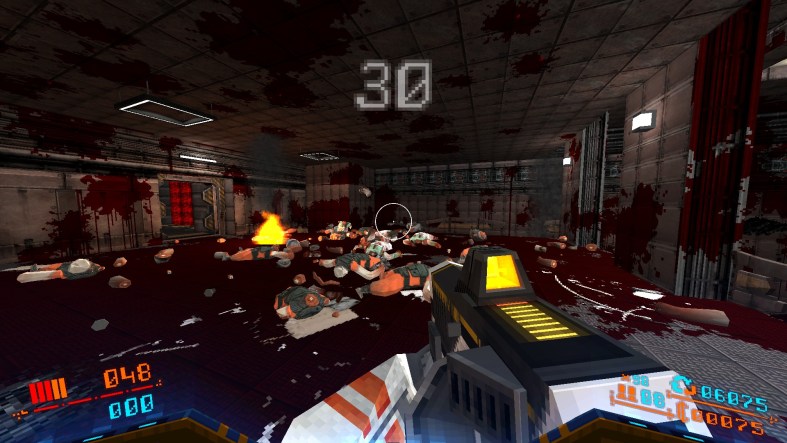
For example, in the above screenshot from the arena mode “Murderzone”, there is some valuable scrap among the corpses, randomly dropped from one of the kills. This is not obvious without careful inspection, or by accidentally walking through it. In the main mode, scrap separates a successful run from one where a player died for want of ammo. Due to the noise, finding scrap can feel arbitrary instead of skillful, which limits the resource management skill of the second loop.

In zone 1, there are also keycards needed to progress through levels, or sometimes there are dismembered heads that need to be matched to an eye scanner. When trying to find a keycard amid the gore, there is no partial failure or partial success. The result of these item hunts is a slower pace with no gains for it.

20170527185233_1.jpg

Another way the game throws the signal and noise skill check at the player is with enemies that leave permanent acid pools on the floor and walls. These acid pools make no sound and deal a small amount of damage per second. As a result, a player who is backpedaling or strafing can take directionless damage and not know whether it is a hazard or a melee enemy, which are also sometimes silent. This clutters the mental map a player has to maintain while fighting, which burdens memory instead of attention.

By comparison, enemy projectiles in Doom have a sound effect attached to them with a fake Doppler pitch shift. The projectiles also play a sound when they hit a wall. These pieces of feedback allow a skilled player to dodge projectiles that they aren’t watching, and know when that information is no longer relevant. The skill in Doom is about threat priority and player attention, not about memory.

Another factor is missing feedback for a first person camera. With a different implementation, the acid’s effect on the player’s resources of health, shields, and map positioning could be an interesting obstacle. For example, Diablo 3 has similar acid-pool enemy attacks that prevent the player from kiting, or force the player to take the damage in exchange for positioning, but Diablo 3 relies on a top-down camera where the effects are always visible. Because Strafe has a first person camera, the same kind of acid-pool attacks require different skills from the player.

Closing Notes

There are other problems with Strafe—ambiguous feedback around upgrades, bad balance around weapons and items—but these are not fundamental. Some weapons and items make combat easier than others, but the combat remains the same. Tuning the balance here would affect difficulty, not player behavior.

The purpose of this framework is to identify what a game is about based on where it checks the player’s skill. Strafe has kiting, target prioritization, and map positioning; these are the basics of Quake, and there are some good moments here. But once players master these basics, the game is about signal and noise and arbitrary resource management. The strafing in Strafe is the easy part.

A puzzle to gnaw on:

The problems with Strafe‘s acid and gore could be fixed at an aesthetic cost (remove or reduce the gore, make the scrap more obvious, add sound to the acid pools, let the acid fade after time, etc.). These changes would affect the play experience and identity of Strafe, remove its rough edges. But if all the rough edges are gone, what does it mean to make a 1996-styled FPS in 2017?

Footnotes

¹ My thinking on this topic is shaped by a GDC talk Matthias Worch gave in 2014, “Meaningful Choices in Game & Level Design”, http://www.gdcvault.com/play/1020570/Level-Design-in-a-Day

² In stealth games there is a related concept of expanding the failure-spectrum to create more drama. Randy Smith wrote about this for Thief 3, which Robert Yang summarized here http://www.blog.radiator.debacle.us/2011/07/dark-past-part-4-useful-post-or-randy.html Despite the obvious benefits of this idea in stealth games, this is a concept I seldom hear discussed for action games.

³ In Super Hexagon—which borrows from the arcade tradition of Tempest and Asteroids—the hue-shifting, value-inverting, and screen-spinning in themselves cannot defeat the player, but they can confuse and misdirect. Mastering Super Hexagon becomes a matter of learning to see what is real, and learning to see past what is not, a concept we also see in puzzle games like The Witness.

Environmental Storytelling and Gone Home

In Gone Home the player is Kaitlin Greenbriar, a young woman who has returned to the United States after a year in Europe. While she was away, her family moved to a new house, and the game starts with the player at the front door, facing a note from Kaitlin’s younger sister, Samantha. No one is home, and the game leaves the player to explore the house and piece together clues from the environment to discover what has happened during Kaitlin’s year away.

Gone Home reveals its story through audio diaries and the environment itself. The former, which come from Sam’s journal, are able to describe what the environment cannot: events that leave no evidence, or events outside the house. The audio diaries also require little interpretation from the player, since they are already Sam’s interpretation of events and details. Instead, they function as a supportive structure for what the player observes in the environment. Some details, like letters or notes passed in class, are as revealing as the audio diaries. Others, like a letter Kaitlin’s dad conveniently saved from twenty years before the story’s events, allow for exposition. These may be necessary to present the player with a coherent story, and they are mostly believable, but the moments where Gone Home’s environmental storytelling works best are more subtle.

There is a long history to environmental storytelling in games, but Gone Home is one of the first to dedicate so much attention to it. In older games, most of the objects in an environment were those that served some function. With limits on computer power, rendering and calculating the physics for many useless objects was cost prohibitive. Because most of these games were first person shooters, this limited environmental storytelling to dead bodies, weapons, and ammo. In some games, like Thief and System Shock 2, there might be evidence of a tripped trap, a note beside the body, or bullet holes in the wall to help the player piece together what happened in the moments before death. The number of unique objects in Gone Home wasn’t feasible until recently, and this is why most environmental storytelling has only been about dead bodies.

Sprung TrapA dead adventurer, some loot, and a trap panel (From Thief 1)

The best definition I’ve found for environmental storytelling comes from the talk, “What Happened Here?” that Matthias Worch and Harvey Smith gave at the 2010 Game Developers Conference. (I recommend listening to the recording and reading the slides if you haven’t already.) Worch and Smith define environmental storytelling as “Staging player-space with environmental properties that can be interpreted as a meaningful whole, furthering the narrative of the game.” This definition fits the examples Worch and Smith give in their talk, and it also fits with most of Gone Home, but their emphasis in the talk—especially their practical tips for environmental storytelling—is on creating chains of events where the player is trying to solve the puzzle of what happened. This is the forensic approach, which has its uses, but it doesn’t explain how some of the stronger moments in Gone Home work.

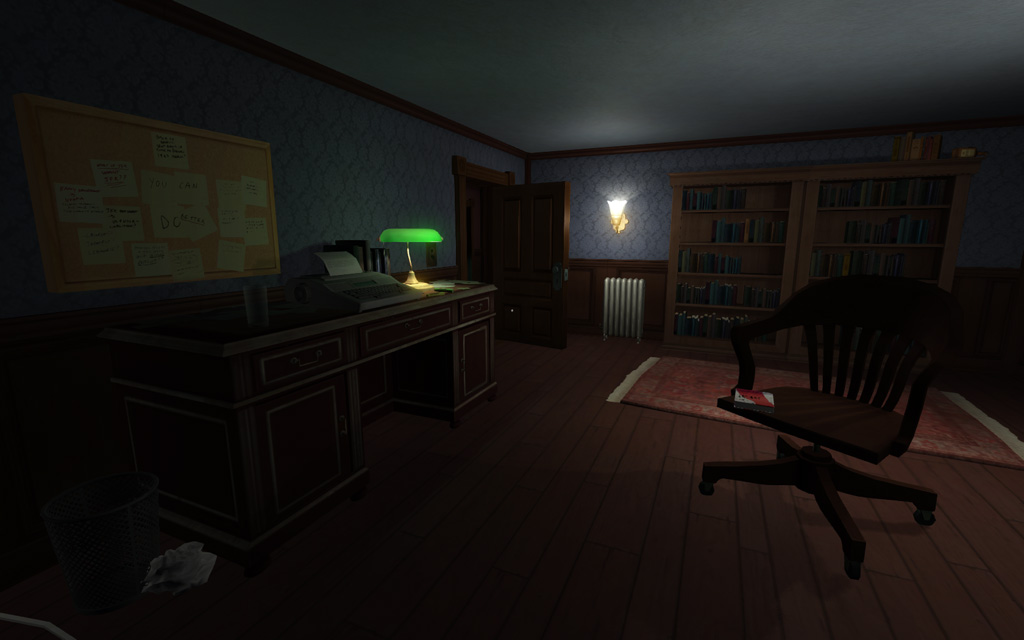
Terrence OfficeTerrence’s Office (Note the whiskey on the bookshelf)

For example, one of the first rooms the player enters in Gone Home is an office where Kaitlin’s dad, Terrence works. Instead of depicting a single sequence of events like a puzzle to solve, the objects in the room reflect a range of actions. The chair is pushed away from the desk, and a book is on the seat, suggesting that Terrence read the book at his desk and then left it on the seat instead of returning it to the shelf when he was finished. There is also a bottle of cheap whiskey hidden above the book shelf. Crumpled pages in a waste basket show attempts at the opening paragraph of a novel, and each page has more typos than the page before it. A cork board is covered with sticky notes outlining ideas for the novel. There is also an incomplete product review of a CD player in the typewriter. More than an exposition-heavy letter or an audio diary, these details tell the player who Terrence is.

It also doesn’t matter if the crumpled pages in the waste basket are from the same night that Terrence read the book at his desk or started writing the product review. The mess of notes on the cork board suggest even longer periods spent working in this room. The combination of details in the office tells us about Terrence’s ambitions and frustrations. Instead of having the environment tell a story, the environment depicts the patterns of behavior that let us imagine the character living in the space. We can see Terrence going for the whiskey to relieve his writer’s block on not just one night, but many; we can see more than the few crumpled pages in the waste basket, but the reams he has thrown away. Instead of “What happened here?” the questions become “Who lives here?” and “What kind of person are they?” It becomes about the living present instead of a dead past.

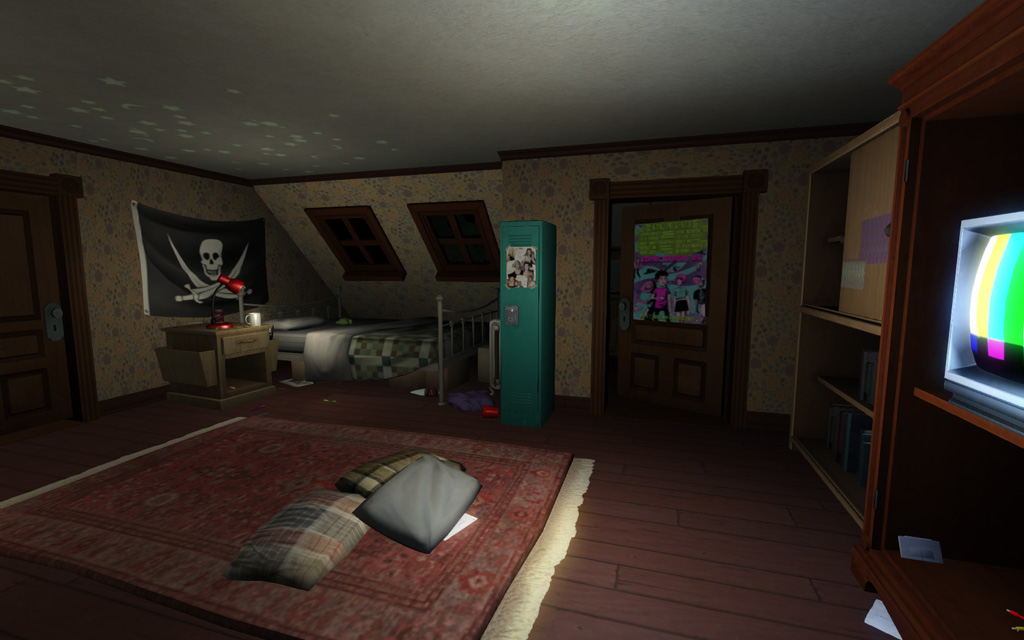
Sam RoomSam’s Room

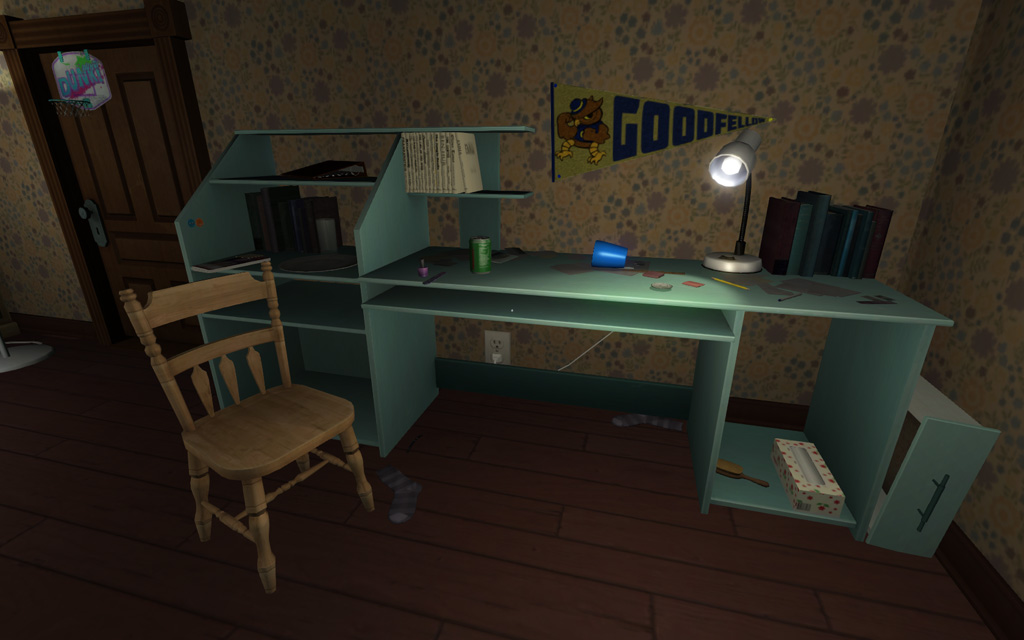
This is also visible in Sam’s room. Where Terrence’s office reflects a certain focus on his occupation and interests, Sam’s room lacks this; it is a teenager’s room. It has an eclecticism from so many interests and ideas built up over years of her life. there is a dinosaur stuffed animal on the bed, a small basketball hoop on the back of a door, and some SNES game cartridges. Sam’s bookshelf has the collection of the kind of classic literature that a teenager reads. Magazines beside the bed and a collage on a locker show Sam’s interests in pop culture. In the closet, there’s the collar of their old cat, Mittens, and a colorful Lisa Frank esque binder from Sam’s elementary school years.

There is a greater sense of sequence here than in Terrence’s office, but it is not the sequence of a single event. The variety of objects show years of Sam’s life building on each other, and the room hints at the process by which Sam has discovered who she is and what she cares about. A discernible chain of events doesn’t really matter here.

Sam DeskSam’s Desk

Showing who a person is and not just how they appear is a struggle in games. A model may capture a person’s appearance and it may show their mood, but the appearance alone doesn’t show who that person is. Early Buddhist artists faced a similar problem with depicting Buddha. Instead of making a sculpture of the man, they created footprints, empty sandals, and empty chairs. They implied his presence without showing him, and this gave the emptiness a sense of space and life that statues depicting Buddha lack. The strongest environments in Gone Home achieve the same effect. When we walk through these rooms, and see the how their occupants have shaped them, they come to life, not as single events, but as months and years played out at once.

On Thief’s Level Design: Maps and Territories

There is a short story by Jorge Luis Borge’s called “On Exactitude in Science” where he describes an impossible map:

In that Empire, the Art of Cartography attained such Perfection that the map of a single Province occupied the entirety of a City, and the map of the Empire, the entirety of a Province. In time, those Unconscionable Maps no longer satisfied, and the Cartographers Guilds struck a Map of the Empire whose size was that of the Empire, and which coincided point for point with it. The following Generations, who were not so fond of the Study of Cartography as their Forebears had been, saw that that vast map was Useless, and not without some Pitilessness was it, that they delivered it up to the Inclemencies of Sun and Winters. In the Deserts of the West, still today, there are Tattered Ruins of that Map, inhabited by Animals and Beggars; in all the Land there is no other Relic of the Disciplines of Geography.

These same ideas—maps and territories, degrees of abstraction—are at the heart of the Thief series. They are what give life to its level design, and distinguish the series from all of the stealth games that have followed.

Each Thief game presents a series of missions where the player usually has to break into buildings, avoid detection, and steal valuables. In setting, the games are a kind of steampunk medieval city, and the protagonist, Garrett, is a kind of film noir hero fit to face the city’s darkness. It’s weird, but kind of works in a pulp fiction way.

The levels themselves are big and spatially nonlinear, requiring the player to explore and gather information before completing the objective. Combined with the tension of hiding from guards—or sprinting through mazes of rooms to avoid capture—and the hours it can take to complete one mission, it is easy to become lost. Because of this, where other stealth games are about gadgets or waiting for gaps to phase in to guards’ patrols, the Thief series is about its level design. Each mission gives the player a hand drawn map of the level they are exploring, but the detail and accuracy of the map varies between missions.

The map has also changed between the games. With Thief 1, the map highlighted the player’s current room. In Thief 2, the map also marked the rooms the player had visited and let the player write notes on the map. Thief 3 stepped back, made its maps less detailed and no longer highlighted the player’s progression through the level. It’s an improvement Thief 3 made on the series that almost makes up for the removal of rope arrows.

In Thief 1’s third mission, a tomb named “Bonehoard,” the map doesn’t reflect the labyrinthine tunnels monsters have burrowed. If the player checks the map, instead of highlighting a room, the highlight appears over the text “Where am I?” Instead of relying on the map, the player must follow the notes left by the dead adventurers who came before and hope the markings they left are reliable. The limits of the map become part of the level’s history and the player’s story.

constantine mapConstantine’s Mansion (from Thief 1)

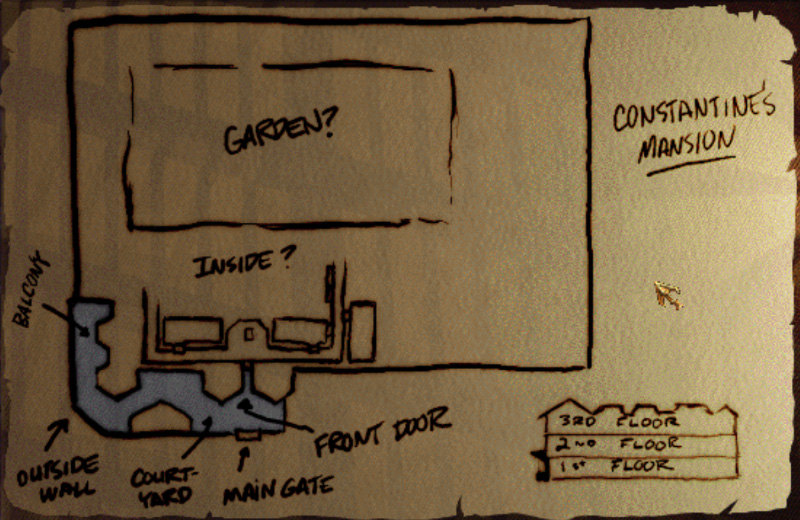
In the seventh mission in the gold edition of Thief (the sixth mission in the original version), the player is tasked with sneaking into an eccentric’s mansion to steal his magical sword, and here the map only shows the exterior of the mansion, and the first few rooms beyond, which is about as much information as the player can gather in 5 minutes of wandering. Where a more detailed map allows the player to plan a course of action and then quickly execute it, as in Rainbow Six where a player can spend more time on the map screen than in the mission, an incomplete map forces the player to slow down, pay attention, and create a mental map in lieu of a drawn one. “Constantine’s Sword” pushes further in this direction by including traps, secrets, and disorienting architecture. The player who treats this mission the way they treated the less complicated manor missions won’t make it far.

When the player checks their map at the start of Thief 2’s third mission, a police station where the player must frame a lieutenant, they will find 5 detailed pages. The map’s rooms are labeled, and important areas are annotated. Instead of aiding the player, the map overwhelms and disorients. However, through the process of playing the level and checking the progress on the map, the map’s abstraction and the level merge, and the player leaves the level with a feeling of mastery.

police stationOne of the five pages of the police station map (from Thief 2)

Because Thief 3 doesn’t mark the player’s position or progress, and because the maps are less detailed than those in the previous games, the player has to rely on the way the rooms on the map are labeled and the way the rooms in the level are decorated. If the player is hiding in a room with few furnishings except paintings and statues, then this may be a gallery, and by checking the map and notes for mention of a gallery, the player can reorient.

Even the details in Thief’s levels are overloaded with meanings like this. In other games, a texture may be a designer or artist’s arbitrary choice, but here the floor material tells the player how slowly they must move to remain silent, how far away they will hear a guard’s approach, and how visible they will be. It also tells the player about the room, whether it is public or private, how many guards and servants they should expect, and where the room lies on the map. All of these details matter as the player determines whether this route is safe. And that’s merely the information expressed by the floor material.

overlook mansionOverlook Mansion is bigger and more complicated than this map suggests (from Thief 3)

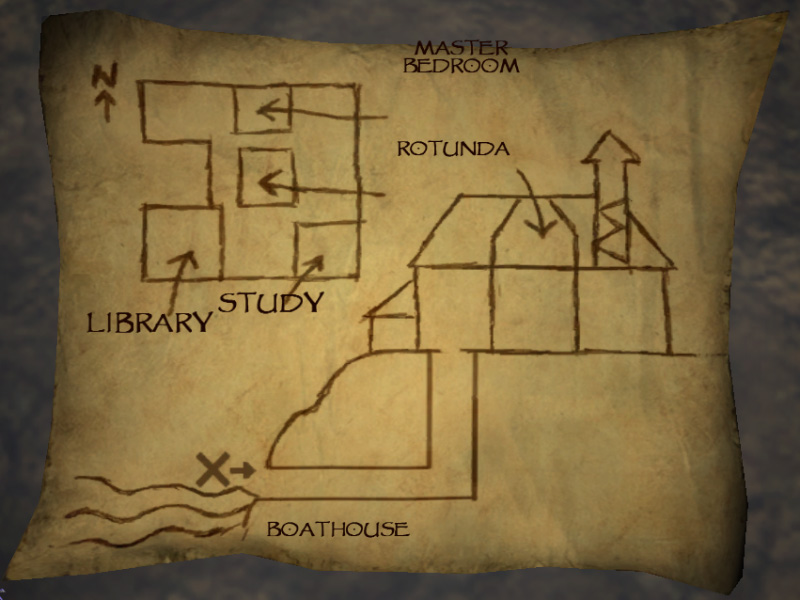
With all of this information to process, a map is useful as an abstraction. It culls the trivial or redundant and preserves the essence. It gives us a literal big picture. Instead of marking the furnishings of a room and requiring the player to infer the room’s function, a map labels the room at a loss of detail: bedroom, study, library, atrium. A detailed map requires the player to infer upward (if the room is furnished with a bed, it is a bedroom), but an abstract map requires the player to infer downward (will there be valuable loot or information in the bedroom? Maybe the key you need? What about guards?). What we call the levels in the Thief series exist somewhere between the physical obstacles and its abstracted representation; they come to live in the mind.

This matter of map versus territory invites other questions. What makes a building a house instead of an office or a factory? What makes a room a library, or a study, or a bedroom, if they all have bookshelves? Do these labels describe or prescribe the behavior within them? How is privacy encoded into these spaces (why does sneaking through a bedroom feel like more of a violation than sneaking through the main hall)? Thievery becomes not just a matter of mastering the physical obstacles, but understanding the social values that are attached to architecture: class, power, secrecy, the divisions between public and private spaces. Of course, this deeper exploration of a level is only true in recognizable structures, like houses, cities, factories, and cathedrals. The more unusual levels—tombs, caves, labyrinths, and ruins—are often too alien, forcing Thief back on its fundamentals as a stealth game.

constantine mansionA corridor from Constantine’s Mansion (from Thief 1)

Of course, many other games have maps, but these are often perfect replicas or pulled directly from the game’s level editor. The map in Splinter Cell: Chaos Theory, like Rainbow Six before it, is basically a wireframe view of the level’s geometry, even when the fiction shouldn’t allow for such detailed information. Because these maps lack bias, error, and are often too complete, they offer none of the mystery and delight of exploring a level in the Thief games. It is through the discrepancies of map and territory that we learn about the person or people who created the map, what they valued, and what they chose to ignore.

Thanks for reading